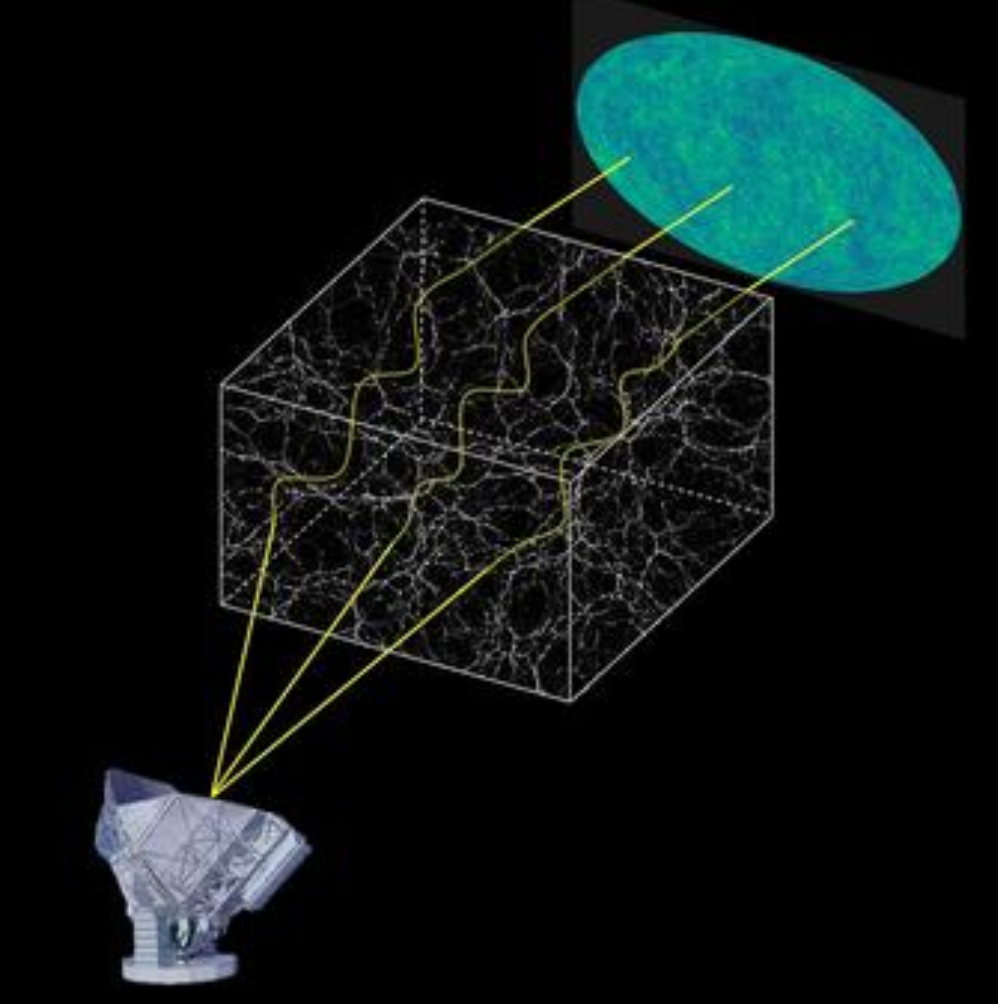

For more than five years, scientists at the South Pole Telescope in Antarctica have been observing the sky with an upgraded camera, picking up remnant light from the universe’s early formation—an afterglow of the Big Bang. They have now analyzed an initial batch of data, and published details in the journal Physical Review D.
The telescope at the Amundsen-Scott South Pole Station, operated by the National Science Foundation, received a new camera known as SPT-3G in 2017. Equipped with 16,000 detectors—10 times more than its predecessor—the SPT-3G is central to multi-institutional research led in part by the U.S. Department of Energy’s (DOE) Argonne National Laboratory.
Afterglow of the Big Bang
The goal: measure faint light known as the cosmic microwave background (CMB)—the afterglow of the Big Bang, when the universe burst forth from a single point of energy nearly 14 billion years ago.
“The CMB is a treasure map for cosmologists,” said Zhaodi Pan, the paper’s lead author and a Maria Goeppert Mayer fellow at Argonne. “Its minuscule variations in temperature and polarization provide a unique window into the universe’s infancy.
Gravitational lensing—warping of the fabric of space-time
The paper in Physical Review D offers the first CMB gravitational lensing measurements from the SPT-3G. Gravitational lensing happens when the universe’s vast web of matter distorts the CMB as it travels across space. Albert Einstein described this warping in the fabric of space-time in his theory of general relativity.
Measurements of that distortion hold clues about the early universe and mysteries like dark matter, an invisible component of the cosmos. “Dark matter is tricky to detect, because it doesn’t interact with light or other forms of electromagnetic radiation, said Zhaodi Pan, Maria Goeppert Mayer fellow at Argonne. "Currently, we can only observe it through gravitational interactions.”
Ideal location
The dry, stable atmosphere and remote location of the South Pole Telescope create as little interference as possible when hunting for CMB patterns. The team used a dedicated cluster of computers at the Argonne Laboratory Computing Resource Center to run some of the calculations for the research.
This work was funded by the National Science Foundation’s Office of Polar Programs and the DOE Office of Science’s High Energy Physics program.
Citation: Z. Pan et al. Measurement of gravitational lensing of the cosmic microwave background using SPT-3G 2018 data, 12 December 2023, Phys. Rev. D 108, 10.1103/PhysRevD.108.122005 (open access)