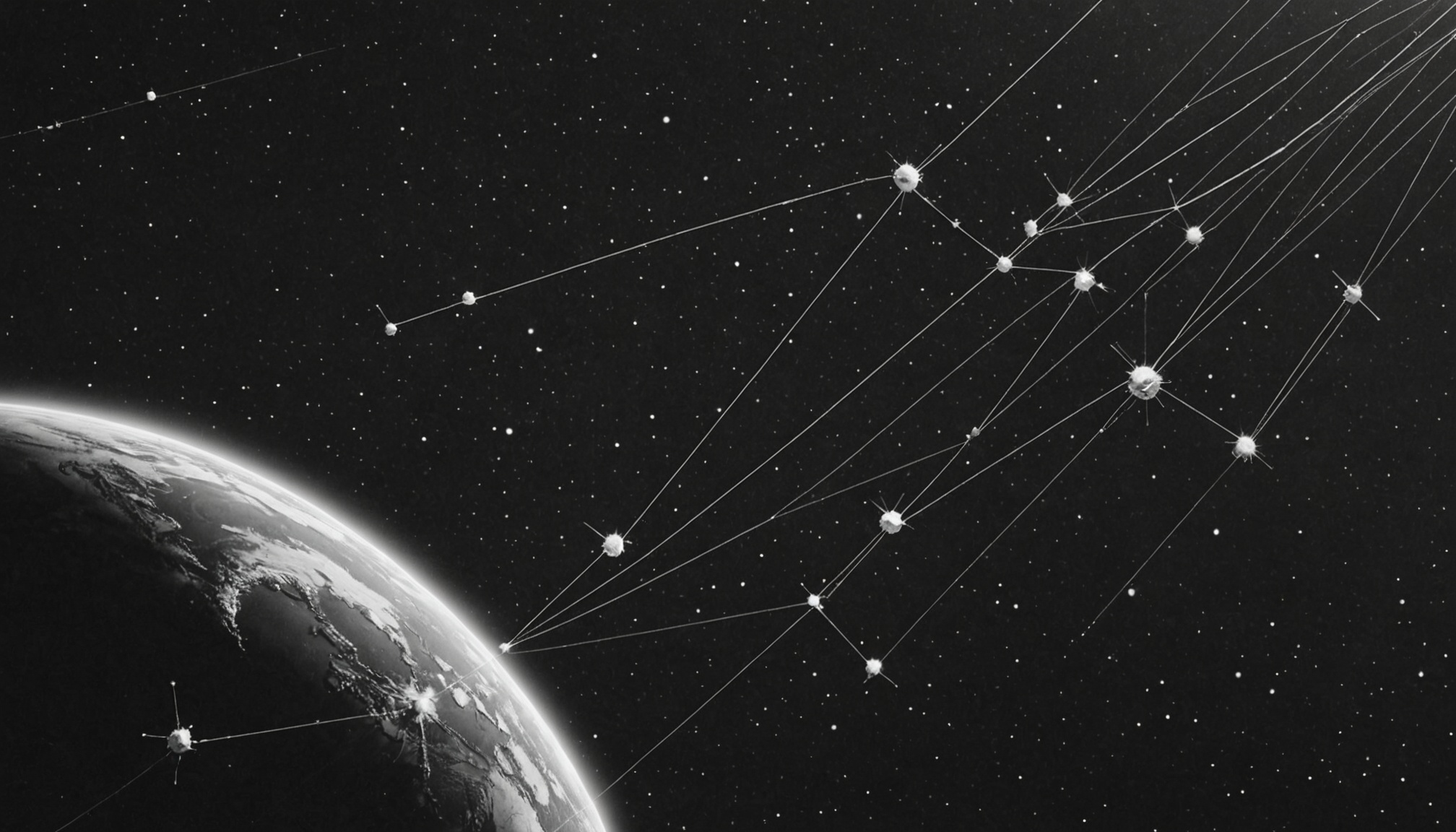


On October 1, 2026, a SpaceX Falcon 9 rocket carried a small satellite into low Earth orbit that could mark the beginning of a new chapter for computing. The satellite, part of Google's Project Suncatcher, carries four of the company's tensor processing units - specialized AI chips that represent the first step toward building data centers in space. The launch came just months after SpaceX went public in June 2026, with both companies betting that the future of artificial intelligence infrastructure lies above rather than on Earth's surface.
The promise of orbital computing
The argument for moving data centers into orbit rests on two related advantages: energy and environment. Satellites in low Earth orbit can access near-constant sunlight, generating what Alphabet estimates as up to eight times more solar power than equivalent installations on Earth's surface. This matters because data centers are becoming one of the world's largest electricity consumers, with projections suggesting they will use around 3 percent of global electricity by 2030 - roughly double their current share.
The environmental case extends beyond energy production to energy politics. Communities across the United States have increasingly resisted new data center construction in their backyards, creating political pressure that makes offshore - or off-world - alternatives attractive. SpaceX has promoted orbital data centers as a way to escape what company materials call the "data center backlash on the ground." By moving computing infrastructure into orbit, companies could theoretically satisfy growing AI demand without imposing further strain on local power grids or generating conflict with residents.
How orbital data centers would work
The current experimental architecture is modest. Google's MVP satellite carries four tensor processing units with the computing power equivalent to a single terrestrial server, drawing one kilowatt of power from its solar panels. According to Scientific American, the satellite will run Google's Gemini AI models for 15 minutes at a time before shutting down to cool, with an expected operational lifespan of one year before it becomes orbital debris.
For a true orbital data center, engineers envision constellations of thousands of satellites working together. Each satellite would carry processing units and solar arrays, linked by laser communications to form a distributed computing network. The architecture would need to handle what engineers call latency-tolerant workloads - AI training and large batch processing rather than real-time applications requiring instant response. SpaceX has announced plans to develop its own orbital data centers using graphics processing units and solar arrays produced with Tesla, targeting deployment what the company describes as "supercompute in space" by 2027.
Technical barriers remain formidable
Several engineering challenges separate today's experiments from practical orbital data centers. Cooling presents perhaps the most immediate problem. Terrestrial data centers rely on fans and airflow to dissipate heat, but in the vacuum of space there is no air. Heat can only be radiated away, requiring specialized radiator systems that add mass and complexity. Google's current satellite must shut down its chips every 15 minutes to prevent overheating - workable for an experiment, but not for continuous operation.
Radiation poses another threat. Earth's atmosphere filters out most cosmic radiation, but in orbit chips are exposed to particle flux that can scramble calculations. Systems must incorporate error detection and correction, running redundant computations to verify results. Engineers have been testing chips by bombarding them with proton beams to understand their failure modes.
Data transmission creates an economic bottleneck. Every calculation performed in orbit must eventually return to Earth, and current satellite-to-ground bandwidth is expensive and limited. Some engineers suggest that the best approach involves processing data in orbit and transmitting only final answers - compressing information by computing results locally rather than shipping raw data downward. Even so, the cost of launching satellites and replacing them as they degrade may consume whatever savings free solar power provides.
Scale presents perhaps the most basic obstacle. Current AI training clusters use hundreds of thousands of chips. Building orbital equivalents would require solar arrays kilometers across, far beyond any space construction project attempted to date. The engineering challenges of assembling such structures in orbit, protecting them from debris, and maintaining them over years of operation remain largely theoretical.
Despite these barriers, the convergence of AI demand and space capability creates genuine economic opportunity. The space economy has historically struggled to find commercial applications beyond communications and imaging. Orbital data centers, if achievable, would provide a major new market for launch services, satellite manufacturing, and space-based infrastructure. Alphabet's stake in SpaceX, currently valued at over $82 billion, reflects this strategic alignment between terrestrial AI demand and orbital infrastructure development. The partnership between these companies demonstrates how AI's growth could finally provide the commercial rationale that space development has long sought.
Future horizons
Looking further ahead, successful orbital data centers could enable developments now confined to science fiction. AI computing embedded in lunar bases could support scientific research and resource extraction without depending on Earth. Mars missions could carry autonomous data centers processing information locally rather than waiting for round-trip signals from Earth. The technologies developed for orbital cooling, radiation-hardened processing, and large-scale space construction would translate directly to planetary surface operations. Whether these visions materialize depends on whether the current generation of experiments can solve the fundamental physics of computing in vacuum - but October's launch suggests that at least some of the resources and will now exist to find out.
Note added by the human editor
This article is a first test of a new feature in OmegaPlex - our AI co-writer - which expands a synposis provided by its human editor. I (the human editor) verified the existence and relevance of the linked material, but didn't change the text written by OmegaPlex. I'm pleased with the result of this first test. My synopsis was:
1. Start with some recent news (Google, SpaceX...) about data centers in space.
2. Continue with the standard arguments for data centers in space (abundance of solar energy, reduction of environmental impact on Earth...).
3. Describe typical architectures for data centers in space.
4. Outline the main technical challenges for data centers in space.
5. Argue that this convergence between AI and space is likely to not only improve AI infrastructures, but also and especially boost the space economy in this critical initial phase, which is important and good.
6. Conclude with an inspiring paragraph that hints at possible future developments, e.g. AI data centers embedded in lunar and planetary bases.