I'm writing this piece in light of (ehm, it is a darkness so I should say in ‘the wake of’ as if any of us will wake up) the recent upheaval around Jensen Huang's departure from Nvidia. I have no interest in the personal drama of any CEO, and the article below won't waste any ink on it either. However, what the ongoing saga offers is a window into the prevailing foolery in Silicon Valley.
Cursed be the man that trusteth in man, and maketh flesh his arm.
JEREMIAH 17:5
Silicon Valley's New Religion: The Billionaire Messiah
In November 2023, OpenAI's board fired Sam Altman. Within three days, more than 700 employees threatened to resign unless he returned. As a stark contrast to the famous two days of the October Revolution, the following three days shocked Silicon Valley and, as well, the AI community all over the globe.
Consider the absurdity. An organization established to develop AI for humanity's benefit nearly disintegrated because it cannot imagine pursuing that mission without one man.Furthermore, when OpenAI's board fired Sam Altman, the stock market reacted! Back then, OpenAI was privately held so we cannot say too much about its stock market. Yet, the more revealing development came three days later, when Microsoft announced it would hire him.
The striking fact is that Microsoft's shares reached an all-time closing high when it announced that it would hire Altman, even though OpenAI itself was still experiencing a serious governance crisis. Interestingly, when OpenAI eventually reached an agreement to welcome Altman back, Microsoft’s stock dipped.
Three years later, OpenAI has reached a reported valuation of $1.25 trillion.
There is nothing more revealing than this incident. We are in the era of corporate personality cults!
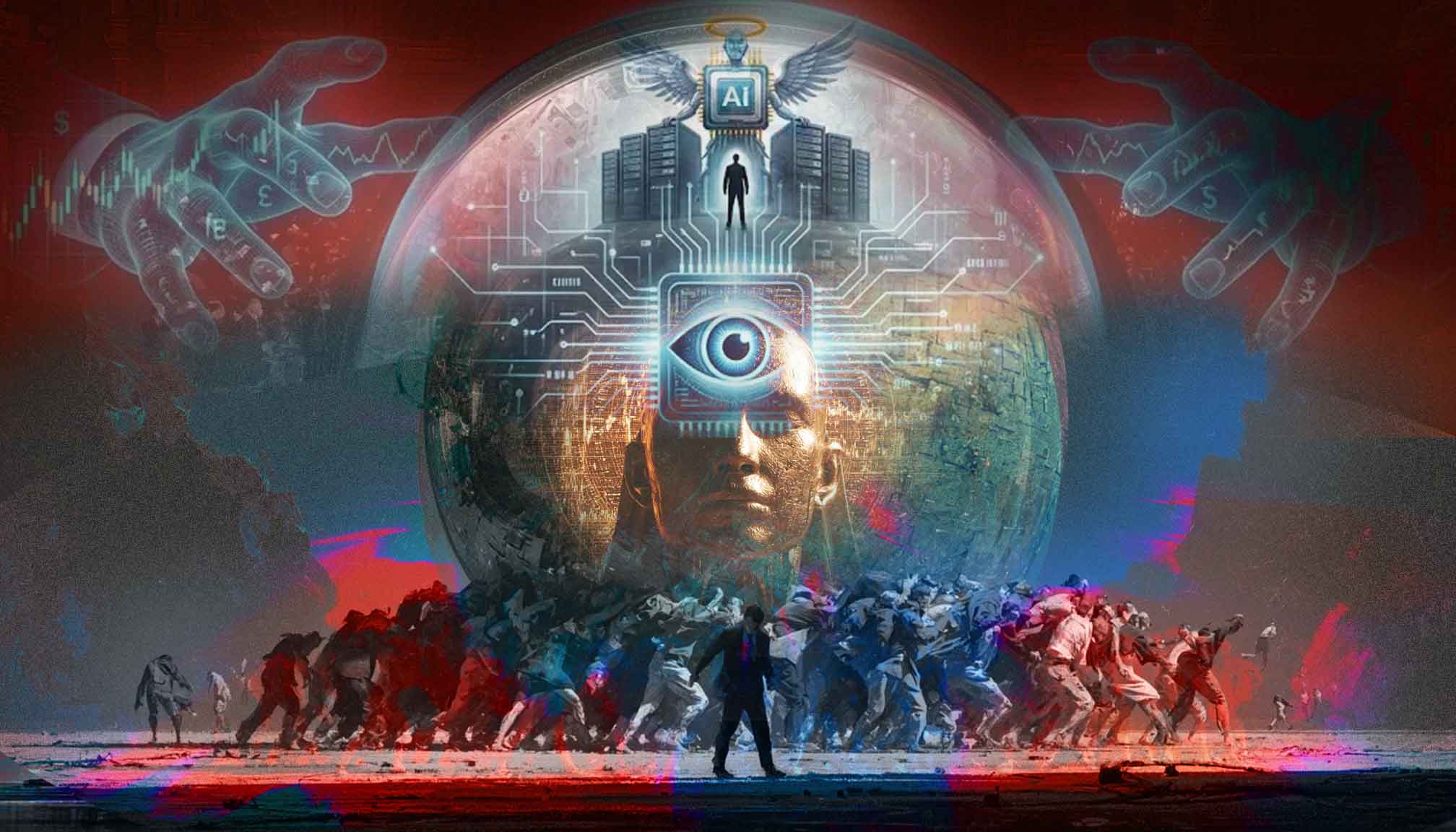
It seems absurd to accuse Silicon Valley as a breeding place of religious zealots, yet it is. When Silicon Valley 'claimed’ to abandon religion, it did not eliminate humanity's appetite for saviors. It simply made room for billionaires! I will say this with the utmost certainty and claim: Silicon Valley has not abolished religion. It has manufactured a particularly grotesque substitute: a religion without humility, a priesthood of billionaires, scriptures written in investor presentations, and salvation measured in market capitalization. The community that once mocked believers for placing faith in invisible gods now places extraordinary faith in invisible future profits.
What an irony! While religious believers are frequently asked to justify their faith, the cult of Silicon Valley is sinless and saintly to the extent that it doesn't explain its market valuations. Yes, its priests and priestesses simply call it financial sophistication.
The worst is that the corporate mythos is becoming a typical superstitious cult and fanaticism is the champion form of logic. However, within this worst culture, there is a worse evil and this cult mythology is used as extraordinarily effective marketing!
My previous examination of Jensen Huang's resignation from NVIDIA highlighted a little bit of this. NVIDIA briefly lost hundreds of billions in market value following its CEO’s departure, although its technology, customers and engineers remained exactly as they were.
Silicon Valley has accomplished something extraordinary! The same technology community that proudly abandoned religion, frequently mocking believers for their irrational faith in invisible gods, has constructed a religion of billionaire messiahs, technological prophecies, and salvation measured in market capitalization. This is ‘technocredulity’ disguised as intellectual sophistication. If I were a Silicon Valley dude, I would have claimed to be recognised for coining the term as it is good for my stock values.
There is an old story in the Book of Exodus about a people who grew impatient waiting for Moses to return from Mount Sinai. They collected their gold, melted it down, fashioned a calf, and began worshipping it. The strange thing about the story is not that they worshipped an idol. Human beings have been doing that for millennia. It is that they made the idol themselves, with their own hands, and then bowed before it as though it possessed some power independent of them.
As every cult has its demon, there is a specter haunting silicon valley (muhahahahaha).
Twelve Potential Burst Points of the AI Bubble
I am not an oracle, but here is my prophecy about the coming of the AI bubble.
I, son of another son and brother to another brother, I, the great-granddescendant of other great-granddescendants, say: When the public and tech enthusiasts applaud before a single word is spoken, when every ambitious prediction is greeted as a glimpse of the inevitable future, and when an executive claims an LLM is AGI, when a rocket man trillionaire promises that money will be obsolete, and when the jackals, ehm, investors (forget the word jackals; it is Satan’s attempt to blur my prophecy) rush to attach a price tag to a world that does not yet exist, behold, people of Earth: when such days are upon us, and when a flightless Blue bird sings, flying east across a grey sky, and the limping bald black wolf appears in the southeast, then the AI bubble will reveal itself!
Putting aside prophecies, let us put a spotlight on some of the leading AI and related technology companies. I have zero interest in exploring their good or bad sides or comparing them. I also want to state these companies are exceptions in any way and am just highlighting them because there is easily accessible and available public information. I hope it will open your eyes and expose different combinations of inflated expectations, charismatic leadership, financing dependencies and speculative valuations.
1. NVIDIA, led by Jensen Huang (no more) used to have a record high of 5.7 trillion dollars in the past and currently its valuation is approximately 4 trillion dollars in market capitalization against 303 billion dollars revenue. Despite enormous earnings, its recent leadership shock demonstrates the dangerous founder premium embedded in investor confidence.
2. AMD, led by Lisa Su exceeded 1 trillion dollars valuaton in September 2026, approaching 20 times annualized sales. The heroic turnaround narrative now faces the unforgiving mathematics of future AI-chip competition.
3. OpenAI, led by Sam Altman witnessed a 1.25 trillion dollars valuation, accompanied by extraordinary revenue growth and continuing operating losses. Investors are told they are purchasing not merely an LLM but AGI supremacy.
4. Anthropic, led by Dario Amodei: registered a 965 billion dollars completed funding valuation and approximately 900.9 billion dollars in infrastructure commitments while its revenue is 33.2 billion dollars.
5. Palantir, led by Alex Karp, reported approximately 407 billion dollars in valuation against 7.3 billion dollars in revenue, roughly 56 times sales. (This one is always surrounded by political theater).
7. Etched, led by Gavin Uberti, launches a specialized chip startup whose valuation doubled to 21 billion dollars within a month.
8. CoreWeave, led by Michael Intrator: Projects 37–39 billion dollars in annual capital expenditure against 13–13.3 billion dollars in revenue.
9. Databricks, led by Ali Ghodsi, boasts a 190 billion dollars valuation against a 7 billion dollars revenue run-rate.
10. Cerebras, led by Andrew Feldman managed to raise 5.5 billion dollars at a 40 billion dollars valuation. Its latest quarter generated 210.8 million dollars in revenue, alongside a negative 106% GAAP operating margin.
11. Figure AI, led by Brett Adcock registered a 39 billion dollars post-money valuation based substantially on humanoid robotics' anticipated future market. The commercial revenue remains far smaller than the financial expectations.
12. Perplexity, led by Aravind Srinivas, is reportedly in talks for a funding round that would value the company at over 30 billion dollars, marking a 50%+ increase from its 20 billion dollars valuation in September 2025. Nvidia is reportedly in discussions to participate in this round raising several billion dollars. Its fundamental test is whether expensive AI-powered search and agent services can generate profits sufficient to justify those extraordinary expectations.
Here, I am not saying such valuations and revenues are indicators of an inevitable collapse. However, I am simply pointing out what the bubble looks like if it bursts (I didn’t say when, did I?).
As I said, the above 12 companies are not exceptions and Silicon Valley valuations have risen far beyond what current or realistically projected profits can justify. In addition, present-day AI and related business are driven by massive infrastructure spending, fishy, and at times in-yourface, circular financings, and heavy debt issuance. I don’t know if it is too late or too early, but the omens of the prophecy are already unfolding. I think it is time to reflect on how much financial capital has been committed to future earnings that remain uncertain.
Monetary Capitalism: The Root of All Evil
I want to go to the origin. Why is this evil circular by its nature? Have you noticed how ‘a bubble’ is also circular? Ehm, then does it mean the Dotcom bubble was twice circular?
When you are honestly assessing the history of bubbles, you will find out that the deeper disease is monetary capitalism: the progressive transformation of money from a medium facilitating productive exchange into something traded principally to manufacture more money.
Let me make the above statement as straightforward as it can. In the ideal and very healthy capitalism, money is advanced to manufacture (this is the best scenario) or buy (in bulk for resale) commodities, services, and labor. Then the commodity and service (minus the labor because to be fair I don’t think slavery fits naturally under capitalism’s model) is sold back for more money. In the evil Monetary Capitalism, money (and its derivatives aka stock, share, debt, etc.) is traded principally to manufacture more money! This is the art of speculative/financial circulation with no productive intermediary.
By the way, I am a fan of George Carlin (not a huge fan though because most of his anger toward God makes me doubt his wisdom. He is a passionate atheist who thinks God is fake, then why is he mad at a fake thing?). May he rot in peace (ah I mean may he rest in peace), he used to critique the use of euphemisms and soft language in English. As he accurately observed, humanity has ‘progressed’ from "shell shock" to "post-traumatic stress disorder" mastering the art of hiding the truth. I am very aware that language is a powerful tool that can obscure meaning. The champions of monetary capitalism are masters of linguistic manipulation that serve to conceal reality and mislead the public (the sheep-like-consumers) about uncomfortable truths, ultimately making communication less vivid and more deceptive.
The euphemism here is ‘Financial Capitalism’. All of the literature, my teachers from my college days, and all the experts today use the term financial capitalism or financialization, and not "monetary capitalism." I use the term ‘monetary capitalism’ hoping that it will be your shell shock!
Today, we dignify stock exchanges and banking systems with the language of financial instruments. But if you strip away the elaborate terminology and some fancy useless maths, all activity under monetary capitalism is nothing but speculative activity, which amounts to buying and selling financial claims for the sake of accumulating more money. Where is the AI? Where is the real deal? Where is the corporation that has little to do with its CEO’s sex appetite and more on the break and mortar of its business?
Why are Silicon Valley companies' valuations disconnected from actual production? A simple answer: In a world where Money chases money, expecting another outcome is simply madness! Hence, the speculators of Silicon Valley profit from expectations rather than production.
Unfortunately, the quest for AI has become the perfect vehicle for this machinery. By the way, this has nothing to do with Nils J. Nilsson (when I was formulating the pun, a loud voice in my head said, “for the sake of AI, Hruy, please leave the guy alone and let him reboot in the forever simulation). Anyway, all I am saying is the world desperately needs genuine technological breakthroughs in the fields of AI to provide credibility to the ongoing extravagant promises ushering in the second coming of the great mighty circular bubble.
The Bank of England estimates that AI-related companies represent approximately half the S&P 500's capitalization in 2026, compared with one-quarter in 2022. Its hypothetical stress scenario examines a 45% U.S. equity decline following a severe AI repricing. I don’t know what more we… the warning is unmistakable: this is no longer merely an AI-sector gamble.As a departing jock, please take a look at the current state of euphemism. I have pasted one paragraph from the above report for your appetite (wow the Brits are much more proficient than the Americans and Goerge Carloin could have a field day if he had a field day in the Bank of England).
What is the sad outcome when (Oh I mean if) the shit hits the fan?
My God, the irony! When I ask Jebediah 6.6 to edit my writing, it tells me “'The shit hits the fan' is an offensive idiom meaning that a situation suddenly causes a lot of trouble”. Then it almost snapped at me and said, “I’m GPT-6, not Jebediah 6.6. You can call me Jebediah 6.6 if you like. I wouldn't feel angry or insulted because I don't experience emotions the way humans do.” Wow, this thing doesn’t experience emotions but has perfectly mastered euphemisms just like humans and is now the master of PC so it will not offend.
Emm so yeah when the shit hits the fan, who gets the faecal situation mate?
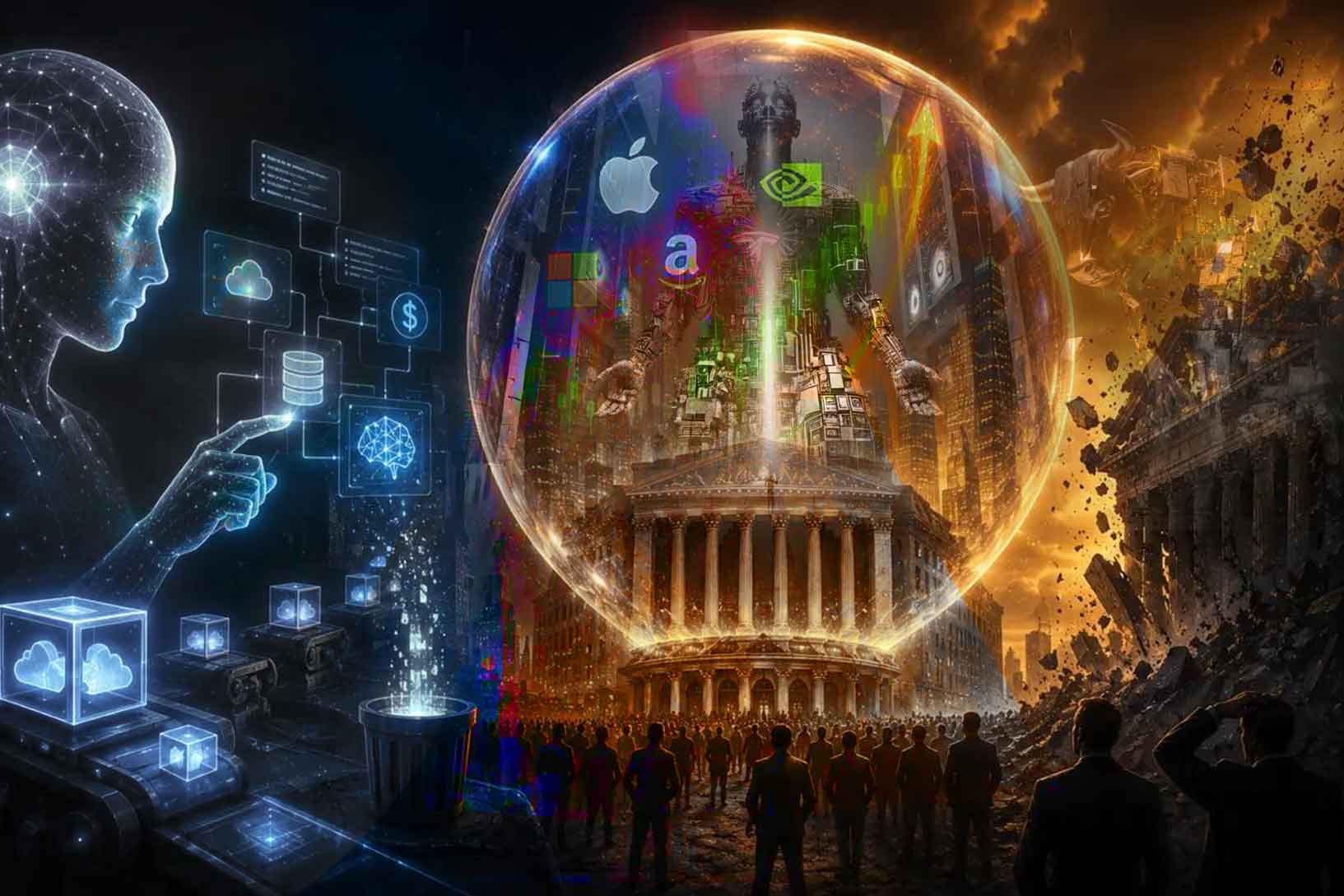
When the Casino Collapses, Who Pays?
I wish I were speculating but history has already answered!
Who paid in the 1929 crash? In the 2002 Dotcom collapse, who paid the 5 trillion dollars loss? In the 2008 housing crash, who paid the 20 trillion dollars?
The 1929 crash cost more than 30 billion dollars (more than 570 billion in today’s dollars). Almost all of that loss was paid by the general public. Despite the fact that only 10% or less of households owned stock back then, the crash cascaded into the Great Depression and the public paid with everything while nearly a third of Americans lost their savings and jobs. The 2002 Dotcom bubble was paid by average individual investors who paid more than 4 trillion of the crash. The 2008 crash was paid by the ‘government’ with 7.7 trillion dollar Fed emergency loans and guarantees. Oh how sweet would it be if things were true as they are on paper… In the immortal words of the mortal Goorge Carlin, "the government does not give a fuck about you... It’s interested in its own power." The "bailout” was paid by we the people, where the public actually paid: 19.2 trillion dollars in household wealth! An estimated 22 trillion dollars was the total cost to the US economy. A 2018 Fed study put the cost at 70,000 dollars per American while all of the involved Banks and corporates (with the exception of a few) went from near-collapse in 2008 to record profits by 2018. As if it were a big FUCK YOU, Citigroup paid 5.3 billion dollars in bonuses in the same year as the crash while receiving 45 billion dollars in bailout money and the other top five banks (JPMorgan, BofA, Wells Fargo, Goldman, and Morgan Stanley) received 63% of the Fed's emergency lending.
So who pays if there is an AI bubble crash in the coming two years?
We have witnessed how the evil of monetary capitalism functions: when its machinery collapsed, governments intervened. In the case of the Silicon Valley led AI crash, America's government is expected to pay (what will Trump say? Should I ask Jebediah 6.6 to imitate him in such a scenario?). So when on paper the mighty US government pays and might even claim the direct money will be returned with profit (as it has stated for the 2008 crash), the grim reality is there will be an economic destruction which will be paid by we the people via inflation, loss of wages, loss of homes, loss of retirement savings, loss of GDP, and every imaginable loss related to the economy. Sadly, the general public will bear the loss of the coming AI bubble entirely. And the saddest possibility is that the governments and the private corporations along with the banks are preparing for the AI bailout.
Even if the lessons of past crashes are catastrophic, we never learn and we still choose to worship Silicon Valley CEOs! I don’t see a fraction of investment in decentralised projects, in opensource projects, in the actual groups of startups that never lie about the status of AI.
Even though I said I am no oracle, I am very sure of this one and that when AI's speculative valuations confront economic reality, powerful institutions may again invoke “too big to fail.” Governments will definitely may be (no pun intended) pressured to rescue Big Tech whose financial commitments have become entangled with the wider economy.
In this new religion, the financiers will always collect their fees. It is the new religion's new gods ultimate decree. In this cult, the CEOs and their early investors will always secure their profits! As it is true for every religion, it is just and fair to doom the sinners. And isn’t it a sin not to aspire for an AI saviour? Yes, the ordinary workers, pensioners, taxpayers, and families, all these dull deplorables who never dare to dream AI as the savior of the 21st century and beyond, yes, these sinners, will inherit the consequences.
This is monetary capitalism's most obscene contradiction: profits are privatized, systemic losses are socialized, and the little people are handed the bill.
I have no doubt AI will transform civilization. However, unless we confront the corporate cults and speculative financial machinery surrounding it, its greatest early achievement may be another historic transfer of wealth upward and another catastrophe paid for from below. It is time to decentralize AI and break the myth of the cult CEO.