

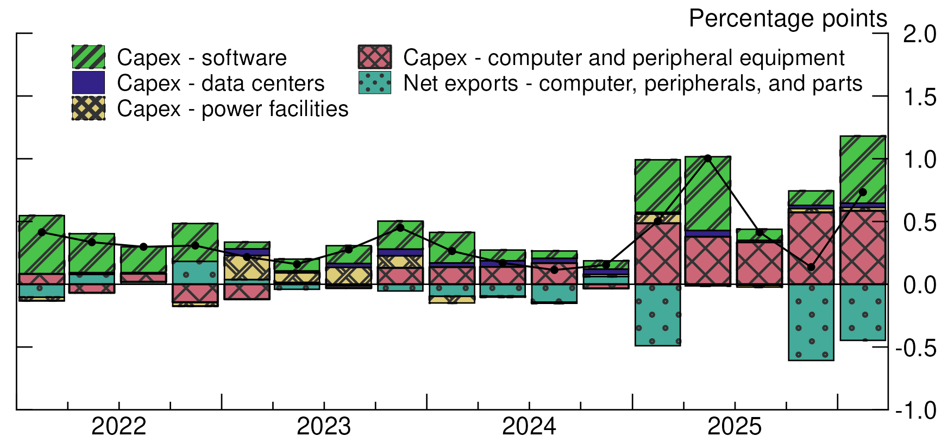
On July 17, the Federal Reserve Board of Governors released a report titled "The AI Buildout and the Economy: Publicly Available Data to Assess AI's Impact." This report is the most in-depth analysis by a central bank on how generative AI is influencing the U.S. economy, and it's quite revealing. The main takeaway? By end of 2026, the evidence suggests that the US economy is changing to adapt to this new technology, with noticeable effects in specific sectors.
The main finding of the note is that, as of mid‑2026, the evidence points to an AI buildout phase rather than the onset of broad‑based economic transformation: capabilities and investment are booming, adoption is rising, and some highly exposed sectors show relatively strong productivity, but aggregate productivity gains remain elusive and labor market impacts are still concentrated with no widespread displacement yet visible. The authors caution that meaningful productivity gains from general‑purpose technologies typically lag investment by years.
For now, AI appears primarily as an upfront cost rather than a significant boost in productivity!
The Investment-Led Growth Pattern and The Productivity Question
On July 14, Fed Chairman Kevin Warsh remarked on this subject, highlighting that spending on AI technology has jumped nearly 25%. The rapid growth of data center construction could even lead to a shift in how we classify AI investments in national accounts. Some independent estimates suggest that investments in AI infrastructure might contribute an extra 0.5% points to U.S. GDP growth in 2026. However, not every one agrees on this positive impact and S&P Global's Q3 2026 outlook underscores that while this investment could drive significant growth, we might also see supply-side disruptions as the sector expands.
Now, when it comes to productivity, there's a bit of a contrast in opinions. The Dallas Fed released a positive analysis on July 7, pointing out that since early 2024, U.S. labor productivity has been growing at an annualized rate of 2.4% which is substantially higher than the pre-pandemic average of 1.6%. The sectors most impacted by AI, like information technology, finance and insurance, and professional services, realized productivity growth of 3.7%, compared to just 1.7% in the rest of the economy. However, the Richmond Fed has a more cautious long-term outlook. Theri publication indicates that AI will boost GDP by only 0.55% to 1.5% over the next 10 years.
Eventhough not as big and not as fast as expected, more reports still point toward a positive outlook when it comes to the impact of AI in the gloabl economy. According to the OECD report, labor productivity in its member countries grew by a modest 1.2% in 2024 and this is double the pace of growth from 2023. Yes reports like these are not depicting the expected hype, however, they still confirmed AI led economic grow in relatively slow pace. On a brighter note, the IMF suggests a bullish future and even warns that the absence of AI contributions would have significantly weakened GDP growth, both in the U.S. and globally.
The Displacement Counterpart
What about job creation and employment? Strangley, the report from the Fed does not touch on the potential issue of job displacement due to AI. Just four days before the Fed's findings, nearly 200 economists collectively warned that we need to address the risks of job loss associated with AI. Research from MIT highlighted that around 11.7% of the U.S. workforce could be replaced by AI. Additionally, McKinsey predicts that by 2030, 60 to 70% of tasks currently performed by humans might be automated. The Brookings Institution also pointed out that AI could jeopardize career advancement opportunities for workers moving from lower-wage jobs to higher-wage ones.
For the moment, the Fed’s report focuses primarily on how to assess AI investments. However, the more complex questions about who will benefit from these advancements and who might get left behind will need to be addressed in future reports.