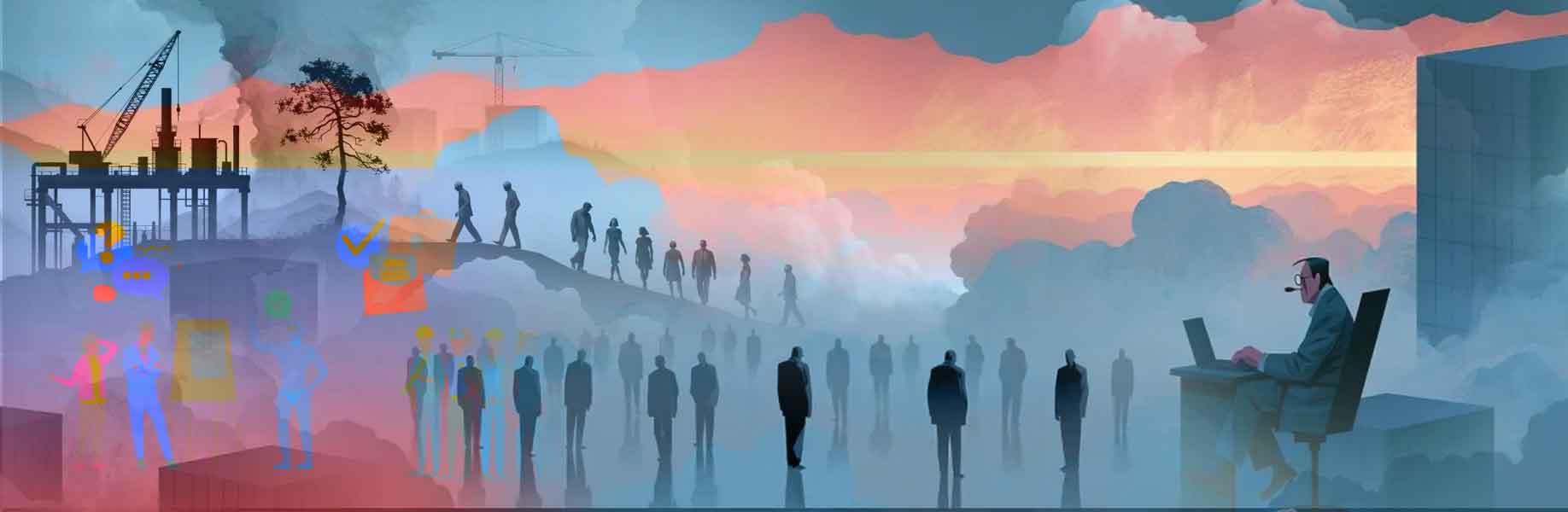

This week, over 200 economists, including 16 Nobel laureates, admitted something the profession rarely concedes: they do not know what is about to happen to the global labor market.
Two Camps, One Fog
The statement, titled "We Must Act Now," does not offer predictions. It offers a confession. "We are driving in the fog, and it is extraordinarily difficult to anticipate what will happen next," said Anton Korinek, a University of Virginia professor and one of the organizers. The letter warns that AI could drive an economic transformation larger than the Industrial Revolution, unfolding not over decades but years, carrying both the risk of large-scale job displacement and the promise of major gains in living standards.
What makes the document striking is not its alarm but its internal contradictions. Signatories include Daron Acemoglu, the MIT Nobel laureate who has spent years as the field's most rigorous skeptic of AI productivity claims, and Erik Brynjolfsson, a Stanford economist who has argued that AI will ultimately create more wealth and more jobs than it destroys. Both signed the same warning. Both admit the evidence is not yet in.
The disagreement among economists, as a recent Carnegie Endowment analysis lays out, boils down to two questions: how fast will AI capabilities actually progress, and how strong will the compensating job creation be? The "alarmed" camp, which includes Anthropic CEO Dario Amodei, believes AI could displace half of all entry-level white-collar jobs within one to five years. The "excited" camp counters that every previous wave of automation, from the steam engine to the internet, eventually created more jobs than it eliminated. Historical precedent, they argue, remains the best guide.
Mindplex has built a, not surprisingly, sustained body of reporting on AI-driven labor disruption, approaching the issue from angles that range from policy and on-the-ground industry shifts to deeper structural critique. Giulio Prisco, our senior editor at the outlet, has tracked the macro picture in pieces like a global survey of how governments are scrambling to retrain workforces for an AI-driven economy, as well as a shorter brief on Bill Gates' prediction that AI will cut human roles in medicine and education within a decade. On the industry side, Linsey Smith documented how AI and robotics are already slashing labor needs on U.S. farms caught between worker shortages and rising costs, while GizmoGuru reported on the concrete fallout of this shift, noting that CrowdStrike cut 500 jobs through AI automation even as IBM pivoted to hire for new tech roles. Mindplex's coverage pushes beyond straightforward "robots are taking jobs" narratives. Matt Swayne argued in a February 2026 essay that AI might not eliminate jobs outright but could instead flood workplaces with meaningless tasks, coining the idea of a "bullshit job singularity". Darshana Patel went further, warning that Universal Basic Income, often floated as the obvious policy fix for technological unemployment, could itself become a trap, a mechanism of control dressed up as comfort in an algorithmic age. Two years ago, Mindplex published David Wood's extensive feature covering the GAIN Summit, which explored experts' recommendations that reskilling and adaptive corporate cultures are essential for surviving an increasingly automated future. Even earlier, in 2023, SB Fisher highlighted the possibility that it may be the middle-class precariat whose jobs become obsolete as AI emerges as the ultimate catalyst for mass technological unemployment. The author of this piece has also written extensively about technological unemployment and the way it could reshape today's value system, dating back to 2012. Yet what do we really know so far? Nothing is confirmed. The question remains open: AI will destroy jobs, and AI will create jobs.
The Concept of a Job Itself
But there is a deeper question that the "We Must Act Now" letter only gestures at, one that neither camp (the alarmed or the excited) fully confronts. What exactly is a "job"? The term implies a stable bundle of tasks exchanged for wages within a recognizable institutional framework. AI does not merely threaten to eliminate specific jobs. It threatens to dissolve the concept itself.
When a large language model can perform the core tasks of a junior lawyer, a customer service representative, or a financial analyst at a fraction of the cost, the link between a defined role and a person's economic identity begins to fray. The Carnegie analysis notes that frontier AI systems are being evaluated as "drop-in remote workers," capable of functioning across entire occupational categories rather than single tasks. The question is no longer whether a machine can replace a task. It is whether the task-based architecture of employment survives when the tasks can be reassigned at near-zero marginal cost to an entity that never sleeps, never unionizes, and requires no benefits.

The Worker-Consumer Paradox
This is where the economic argument takes a particularly uncomfortable turn. Every worker is also a consumer. Wages paid to employees circulate back into the economy as purchasing power that sustains the very businesses doing the hiring. Retire the workforce and you retire, in slow motion, the market those workers sustain.
Recent research by economists Hemenway Falk and Tsoukalas formalizes a paradox that many business leaders have begun to intuit: even when every firm understands that mass automation will erode aggregate demand, competitive incentives trap them in an acceleration dynamic. Each firm captures the full cost saving from replacing its workers but bears only a fraction of the resulting demand destruction. The rest falls on competitors and on the economy at large. Under competitive conditions, the researchers find, firms automate at roughly twice the collectively efficient rate, not because they miscalculate but because the pricing structure of competitive markets dilutes each firm's share of the damage it causes.
The result is not a transfer from labor to capital. It is a deadweight loss that harms both. Aggregate profit falls below what cooperative restraint would produce. Worker income falls further. The economy shrinks in ways that no single actor intended or can individually prevent.
What Replaces Work?
If the current trajectory holds, the implications extend beyond employment statistics into the architecture of value itself. Capitalist economies have, for centuries, organized social participation, political power, and individual identity around the institution of paid work. What replaces it is not clear.
Universal Basic Income is the most frequently proposed answer, but UBI addresses only the income side of the equation. It does not address what a post-labor economy values, how status is assigned, or how political power distributes itself when the wage relationship no longer mediates between individuals and the economic system. A society in which purchasing power is distributed but purpose is not is a society with a new and unresolved problem.
Robert Shiller, the Nobel laureate who shared the 2013 economics prize, has warned separately that the fear narrative itself may become self-fulfilling: when millions of people make economic decisions based on the expectation of job loss, their collective behavior can produce the very outcome they dread. Consumer sentiment is already at record lows, and some economists believe the AI narrative is contributing to a pre-recessionary freeze in spending and hiring. What the "We Must Act Now" statement makes clear, in its deliberate ambiguity, is that the economics profession is no longer divided between optimists and pessimists. It is united in uncertainty. And that uncertainty may be the most honest assessment available right now.