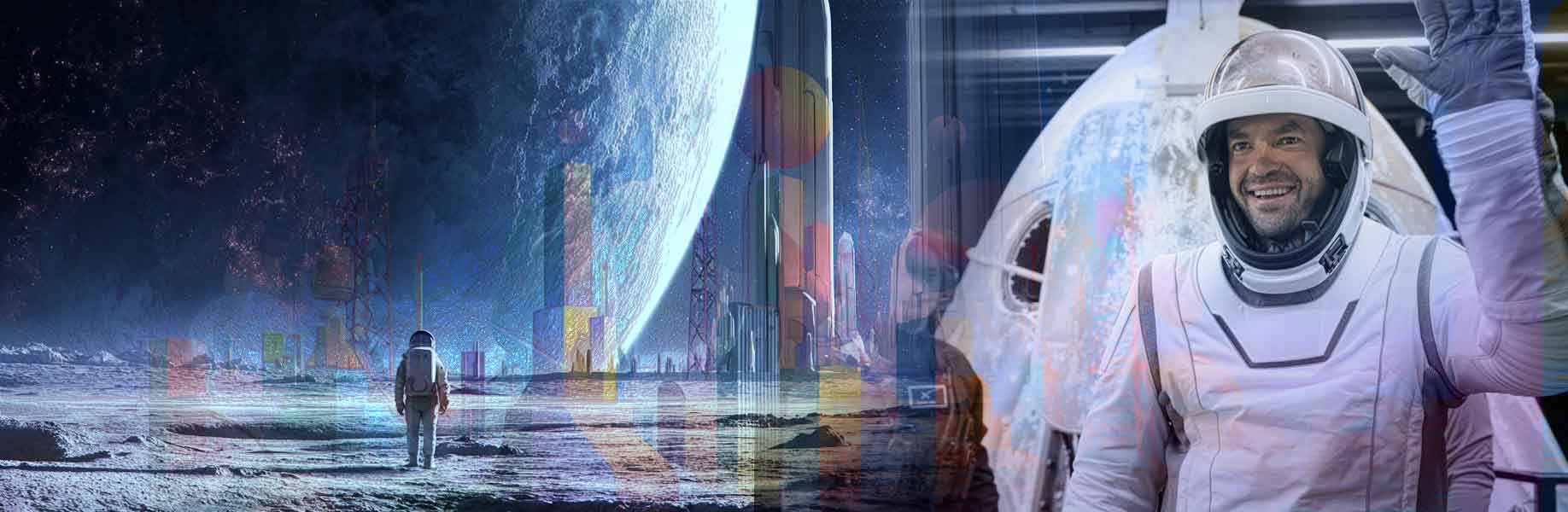
Lara Trump interviewed Jared Isaacman, the newly confirmed 15th NASA administrator, at the Kennedy Space Center. The interview, aired by Fox News and available online via YouTube, outlines Isaacman’s plans and priorities for NASA and can provide a feel-good boost to the motivation of all space professionals and enthusiasts.
To the Moon and beyond
Trump congratulates Isaacman on his appointment, noting that it seems like one of the coolest jobs in the US government. Isaacman agrees, expressing enthusiasm about working with top rocket scientists and engineers. He highlights NASA's historic achievements, such as sending astronauts to the moon over 50 years ago, and points out that the agency is now just weeks or months away from launching American astronauts around the moon again, this time with plans to establish a permanent presence.
Isaacman discusses what excites him most in his new role. He emphasizes President Trump's national space policy, which he describes as the most ambitious since the Kennedy era. This policy goes beyond returning to the moon; it includes building infrastructure like a moon base to allow astronauts to stay and explore scientific and economic opportunities on the lunar surface. He mentions investments in nuclear-powered spaceships to enable the next giant leap to Mars and beyond. Additionally, the policy aims to create an orbital economy, shifting from taxpayer-funded missions to a model where private space stations proliferate. Isaacman also stresses expanding scientific missions, such as sending more rovers to Mars, to unlock the universe's secrets. He calls this "living the dream," surrounded by the right people and resources.
The conversation turns to restoring NASA's mission-first culture. Isaacman says every NASA employee wants to create world-changing headlines, but over time, bureaucracy can hinder progress. His goal is to liberate engineers, scientists, and astronauts from red tape, focusing resources on core objectives like American leadership in space. This includes returning to the moon, building a base, preparing for Mars, and increasing the frequency of missions like those with Hubble, James Webb Space Telescope, and Mars rovers. He believes the workforce is aligned and ready to adapt for better outcomes.
Trump inquires about upcoming launches at Kennedy Space Center, specifically Artemis 2, the first crewed mission toward the moon since Apollo in 1972. Isaacman describes it as mobilizing NASA's best resources for repeat missions and a lunar base. He mentions plans for rovers to mine helium-3 on the moon. Artemis 2, set for the first half of the year, will send astronauts around and beyond the moon, farther than any humans before. The crew will test systems like the Space Launch System (SLS) rocket, boosters, Orion spacecraft, and manual piloting. This will prepare for Artemis 3's lunar landing, where infrastructure for the base may already be in place.
Isaacman elaborates on laying groundwork for President Trump's vision of planting the American flag on Mars. He finds it inspiring to aim for another planet for the first time, calling it achievable under the new space policy. Key to this is investing in nuclear power for space propulsion, which he says will "make nuclear great in space again."
Public-private partnerships
Isaacman views combining government efforts with industry innovations as NASA's unique strength. Public-private partnerships, like those with SpaceX and Blue Origin, are important game changers. Isaacman notes that in the 1960s, NASA had massive budgets, but now, with fiscal constraints and a focus on reducing national debt, creativity is needed. Wealthy entrepreneurs are investing in space capabilities vital for national security and humanity's benefit. Companies like SpaceX, Blue Origin, Rocket Lab, and Stoke are developing rapidly reusable rockets to lower costs. Pairing these with NASA's expertise ensures U.S. leadership, fosters an orbital economy, and enables more frequent telescope and rover launches.
Inspiring the next generation
Isaacman is a risk-taker: he left school at 16 to start a company, set a world record as a pilot, and performed the first commercial spacewalk as a private astronaut. In the interview he says that NASA is the ideal place for breakthrough work, citing its history of achieving the impossible, like moon landings. He explains that the agency inspires the world and motivates children to pursue further advancements.
Asked how his 9- and almost 12-year-old children view his accomplishments and new role. Isaacman admits his kids, growing up around space activities, aren't as impressed as he might expect, though he's steering them toward engineering. He believes that seeing astronauts on the moon again will inspire all children, including his own, to become engineers and scientists. This, he says, contributes to humanity's greatest adventure.
My commentary
I’ve watched the interview twice. Overall, it portrays Isaacman as an enthusiastic leader committed to revitalizing NASA through bold policies, reduced bureaucracy, and partnerships. He emphasizes inspiration, innovation, and achievable goals like lunar bases and Mars missions, aligning with President Trump's vision for space exploration. The tone is optimistic, focusing on America's potential to lead in space while addressing practical challenges like costs and efficiency.
A few days after the interview, NASA and the US Department of Energy (DOE) have partnered to advance nuclear power for space missions. This is in line with Isaacman’s vision for a new NASA and seems to reflect the growing awareness that nuclear power is not a bad thing but a good thing.
One thing that worries me is that, despite the bipartisan support he received (16 of 46 Democrat senators voted for him), Isaacman appears strongly aligned with President Trump, at least as far as space is concerned. At this moment, his being part of Trump’s circle is an advantage. But politics is a rapidly changing minefield, and if the Democrats win the 2028 elections the next US administration could be hostile. In view of this risk, it seems reasonable for him to do as much as he can in the coming three years to firmly set NASA on a new course that can’t be easily reversed.
The Apollo program of the sixties can be seen as a failure because we abandoned the lunar exploration program. But it was a success instead. It provided endless inspiration to the generation that developed the internet and much of modern technology including artificial intelligence (AI). This bold, optimistic interview suggests that Isaacman and his new NASA will be uniquely able to provide the next generation with a continuous source of inspiration, one that won’t last only for a few years.
Artemis II could launch in the first week of February. Isaacman admits that there could be delays, but says that Artemis II will happen “in the first half of this year for sure.” I see Artemis II as the beginning of the new NASA and the beginnings of humanity’s expansion into the solar system.