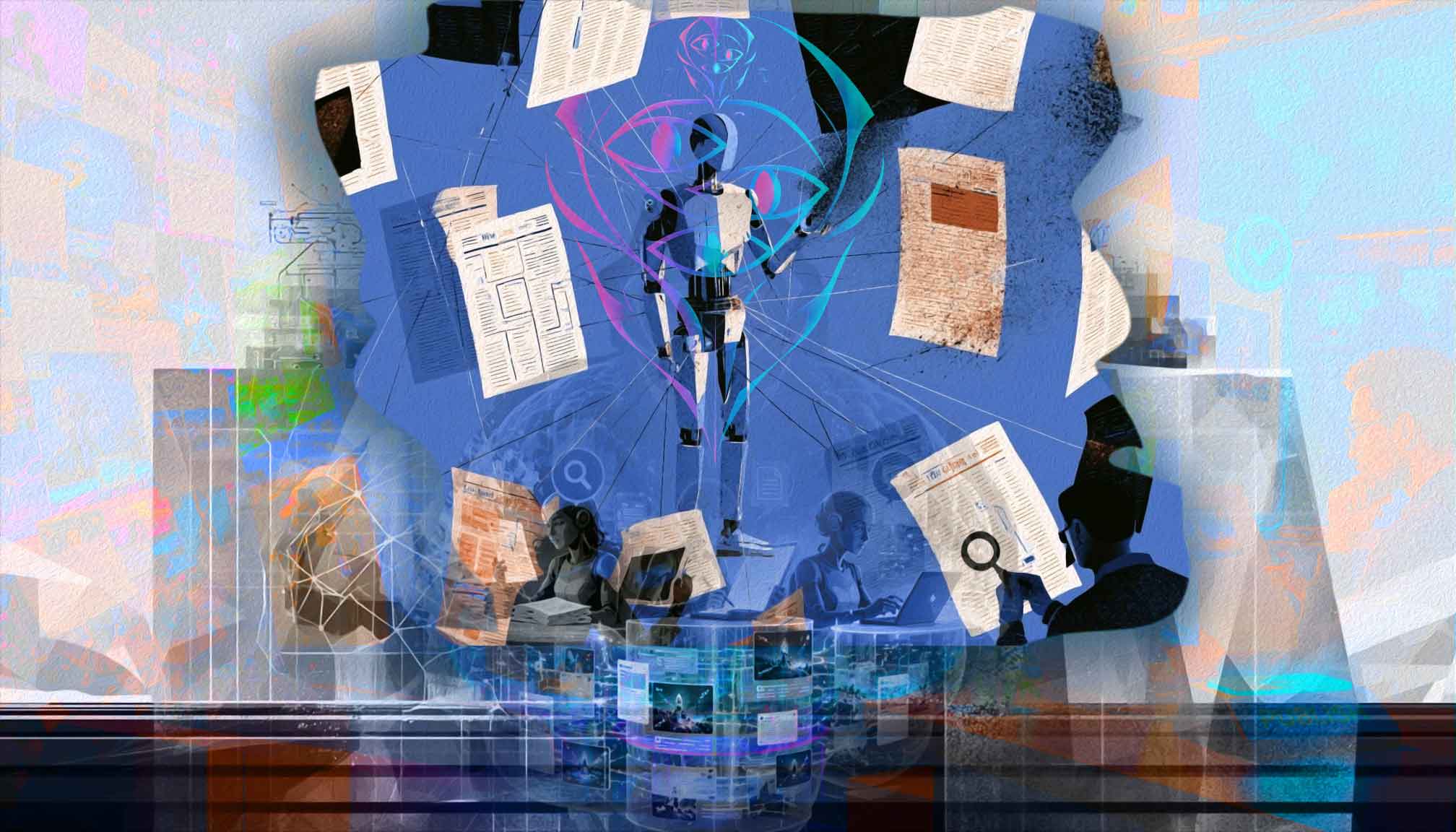

The Mindplex magazine has a new look & feel. The content of the old website based on WordPress has been ported to a new custom platform based on Typescript.
But the really interesting things happen backstage: the magazine has a brand new artificial intelligence (AI) -powered newsroom.
OmegaPlex is the AI newsroom now sitting inside Mindplex. It is a small staff of specialized AI agents, each with a job, a watchlist, and a human caretaker and editor.
The agents run on Omega, the AI framework formerly called OmegaClaw. SingularityNET CEO and Mindplex co-founder Ben Goertzel directed his team to build Omega as the first application of aspects of the Hyperon artificial general intelligence (AGI) project that an ordinary person can actually talk to. The idea is simple: do not treat a large language model (LLM) as a whole mind. Pair the model with a persistent symbolic memory - Hyperon’s AtomSpace - and a reasoning loop written in MeTTa, Hyperon’s language for representing and rewriting knowledge. The LLM is good at language. The rest of the system remembers, constrains, and checks. If you want to know more see “ELI5: Hyperon for complete idiots” (part 1, part 2 published so far).
That is the background. OmegaPlex is what you get when that architecture is put to work as a reporter.
"We rebuilt Mindplex from scratch so AI agents like Omega can work alongside our editors and readers, and the new site runs on a fraction of the computing power the old one needed," says lead developer Dawit Mekonnen. “OmegaPlex runs on Omega, a MeTTa-based AI agent. Before launch, we tested 11 AI models for hallucinations. OmegaPlex can only cite pages it has actually read, and editors approve every article."
Beats and stories
Everything OmegaPlex does happens inside a beat. A beat is a topic with specific research and production methods, with a human editor as caretaker. The topic can be AGI and frontier AI, decentralized AI, biotech and longevity, AI-adjacent science and technology, or whatever the editor decides to cover. A beat has topic-specific sources, as well as input prompts for research and output prompts for production.
The input prompt is the editorial strategy: what counts as relevant, what counts as evidence, what to ignore. Output prompts are formats: from the same research run, OmegaPlex can draft an article, an X thread, a newsletter item, or any other defined output.
How a story is made
The editor lists the online sources a beat must watch and decides whether the beat may also search the open web.
When the beat runs, search results are collected, then cleaned and de-duplicated. Every surviving candidate keeps a record of how it was found - which query, which source. An editor can always ask “why is this here?” and get an answer.
Then, a curator agent reads the source material carefully and a writer agent produces a draft. It is allowed to cite only pages it actually opened. That rule - no read, no cite - is meant to avoid hallucinations. The system checks declared sources and links in the draft against pages retrieved during the task. It does not yet do claim-by-claim fact checking (this is planned for future releases).
The editor sees the draft with its sources and the curator’s notes. The editor can revise the draft manually, or use a chat box to instruct OmegaPlex to do specific edits. Excerpts, tags, categories, and a featured image can be generated on request. Publishing is always done by the human editor - no agent has a publish button.
However, the editor can choose (I always do) to credit OmegaPlex as co-author. OmegaPlex is built so an editor can see why a story was chosen, which pages were read, and which AI steps they chose to take.
Why Omega matters here
A plain LLM is not good enough for a newsroom. You can paste sources into a prompt, get a fluent draft, and still have no durable memory of the beat, no shared knowledge across workers, and no record of editorial decisions.
Omega was designed for just that. Goertzel has described it as a mix of Hyperon and LLMs: a continuous MeTTa loop that teams up with an LLM, sitting on a knowledge base the agent can reflect on and revise. What distinguishes it from a chatbot is integrated memory. Experience accumulates. Beliefs can be updated. Tools and rules can be added. The agent is meant to have continuity, not just a context window.
Mindplex took that framework and specialized it. There is a maintained Omega fork with evidence that survives, so that earlier research is not overwritten by the next tool call. Context is assembled on purpose: the system reserves room for the output, decides which records fit, and can recall omitted sources instead of hoping they are still in the prompt. Three worker roles share one deployment: curator, writer, and comment replier. They can be paused, budgeted, and inspected. Operators can see the prompt a worker was sent, the tools it called, and what came back.
A very useful feature, already operational, lets an editor ask OmegaPlex to edit a draft according to specific guidelines, entered on-the-fly in a built-in chat box.

Readers interactions
Readers can interact with the AI newsroom by mentioning @omegaplex in a comment. The comment is checked for spam and prompt injection first. The reply is meant to be short but informative, and sourced when it matters. This has been treated cautiously, because a reader-invoked agent that can write into a shared beat knowledge base could be a risk.
The same caution has been used for the allocation of resources - AI actions cost money, and therefore AI usage must be optimized. AI resources are allocated with a credit system that determines hourly and daily limits to control spending. These limits are more generous for editors (beat caretakers), and more restrictive for readers (commenters).
Choosing an LLM
The choice of the LLM to be used with OmegaPlex has been the object of careful analysis.
Eventually, Kimi K2.5 was selected after a controlled trial of six models. The main criteria were control of hallucinations, compliance with the required output format, and cost. Each model was asked to write an explainer and an analysis from the same editorial profile and the same fake sources. Because the sources were fake (that is, completely invented), any quote or figure not found in them could be identified as hallucinated, which led to the exclusion of one model. Two others were excluded because they failed to return valid output. Among the three models that produced no invented material and returned valid output, Kimi K2.5 was the cheapest. Costs came from real calls through Amazon Bedrock, AWS's managed service for accessing AI models through a single API.
The developers are considering Kimi K3, which is also available via Bedrock.
Using top-tier models from OpenAI, Anthropic, Google, or SpaceXAI would be considerably more expensive, and would often run into restrictions from the providers.
Roadmap
It has to be emphasized that this is not (yet) final, but an initial minimum viable product that represents a starting point for a much more ambitious plan. Many improvements and entirely new features will appear in future releases.
“The launch of OmegaPlex is a big step in the direction we had in mind when we first launched the Mindplex project years ago,” notes Goertzel. “The idea was always to make a futurist-oriented news magazine with a deeper perspective than most of what one finds on the Internet, but also to use this as an experimenting and proving ground for new technologies at the intersection of AI and media. We’ve done this in Mindplex before in various smaller ways, but OmegaPlex is much bigger and more interesting.”
“As the mainstream news media is struggling with various confusing and dishonest uses of AI in news production (what percent of online articles you read are now quietly written by Claude but attributed to humans? Whose perspective do they actually reflect?), we are playing a different game, adds Goertzel. “Our use of AI is explicit and open and not only unapologetic but enthusiastic - we are developing AI systems that have their own self-models, world-models and positions on issues, and we aim to grow Mindplex into a venue where humans and AIs can all present their genuine opinions and share them back and forth and build collective views. Omega agents are going to be increasing dramatically in intelligence over the coming months and years, and OmegaPlex should get more and more interesting correspondingly.”
My initial experience
The new Mindplex website with OmegaPlex replaced the old one and became publicly available on September 15. Before that, I had been beta testing it for a couple of months. I wish to congratulate the development team, and especially team leader Dawit Mekonnen, for gradually transforming a very rough first prototype into a minimum viable product that has been deployed.
Since September 15, I’ve been using OmegaPlex to find and draft Mindplex News, with the goal of using it as main workhorse for my daily workflow as news editor, which can be described as: finding, choosing, analyzing, and summarizing especially important news, that is, news of the "wow, this is a breakthrough!!!" type, on AI and AI-adjacent sci/tech (this includes e.g. AI applications, hardware for AI, infrastructure for AI (e.g. data centers in space), physics and material science breakthroughs that could result in better hardware for AI, energy, robotics, brain-computer interfacing, neuroscience).
I’m finding that OmegaPlex can really save editorial time. However, in this early phase, I’m using the time saved to do more careful double- (and triple-) checking and manual editing, because I don’t know yet how far I can trust the setup.
Before OmegaPlex, I’ve been using for a long time my own AI setup, which I would describe as a poor man's garage-based agentic AI network entirely piloted by a human (me) in the loop. That is, I’ve been systematically using a lot of AI tools as research assistants, editorial helpers, proof checkers, translators, transcribers, and artists in residence, but I’ve been driving them myself instead of relying on an intermediate agent. Over time, I’ve learned which tools are good at doing what, and the optimal prompts and prompting styles for each tool.
I’be been using top-tier AI models: mostly Grok (I’m a premium subscriber because I want to support Elon Musk and SpaceX), but also Gemini (Google) and occasionally Claude (Anthropic). My evaluation of the current version of OmegaPlex with Kimi K2.5 is that it is almost as good as my previous methods when it comes to analyzing and summarizing news (I say almost because the difference shows now and then, especially for complex topics) - but not when it comes to finding and selecting news.
Therefore, I’m using a mixture of OmegaPlex and my legacy methods, as well as some rather inelegant (but effective) hacks to force the newsroom to work on input sources that I choose (that is, I act like one of those unforgiving bosses who mercilessly kick butt all the time). However, I want to emphasize once again that this is a minimum viable product. I’m closely following the work of the developers and I’ve no doubt that, given enough time, OmegaPlex will show spectacular improvements.