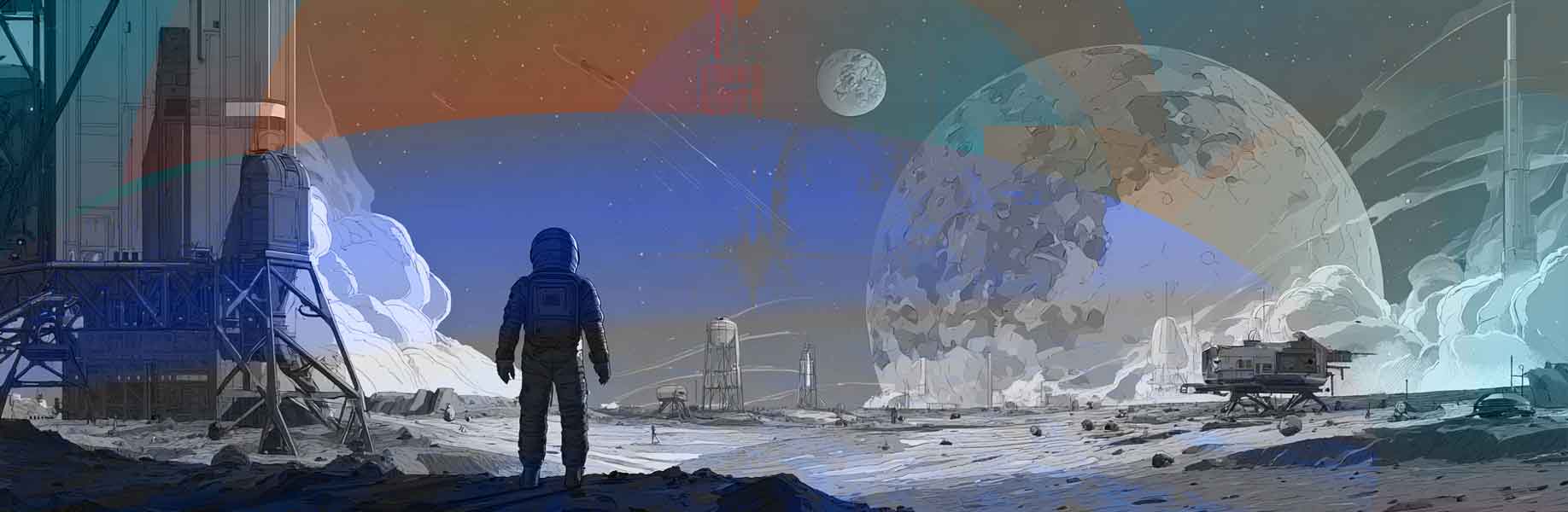
So it’s happening: we are going back to the Moon.
Artemis II: around the Moon
The SLS rocket and Orion spacecraft to be used for NASA's Artemis II arrived at Kennedy Space Center's Launch Pad 39B on January 17, setting the stage for key tests before the crewed lunar mission. In the coming days, NASA engineers will conduct various tests, such as fueling with super-cold propellants and countdown procedures.
The SLS, a super heavy-lift rocket, sends Orion to the Moon. Orion features a crew module for astronauts and service module (built by ESA) for propulsion. This mission paves the way for exploring the lunar surface, with the goal of establishing a permanent presence on the Moon and then advancing to Mars.
Artemis II will be NASA's first crewed mission in the Artemis program, testing the Orion spacecraft and Space Launch System (SLS) rocket in deep space. Four astronauts - NASA's Reid Wiseman (commander), Victor Glover (pilot), Christina Koch (mission specialist), and Canadian Space Agency's Jeremy Hansen (mission specialist) - will embark on a 10-day journey around the Moon and back. This follows the uncrewed Artemis I, aiming to validate life support, navigation, and operations for future lunar landings on Artemis III and Mars missions.
The mission begins with SLS launching Orion into Earth orbit. The astronauts will conduct a proximity operations demonstration, manually piloting Orion near the separated interim cryogenic propulsion stage to test docking. After system checks, including life support, communication via NASA's Deep Space Network, and radiation shelter tests, Orion will perform a translunar injection burn to head toward the Moon.
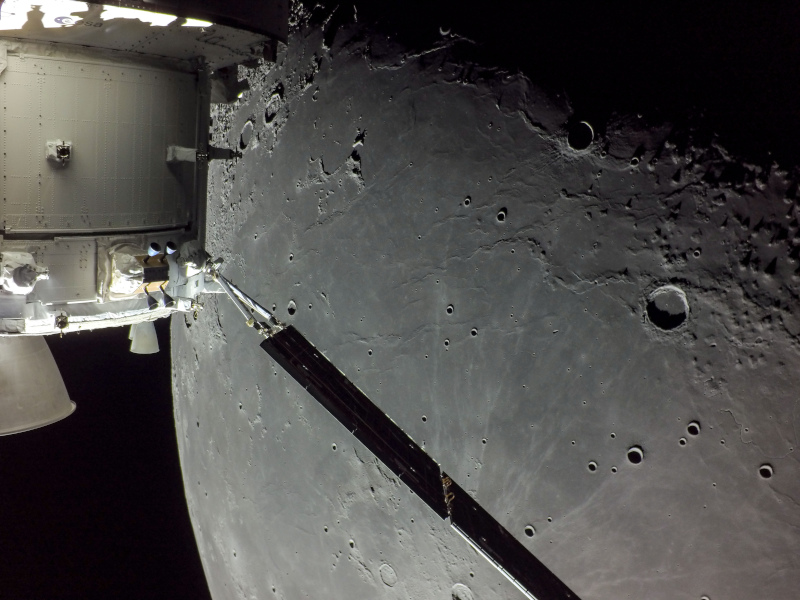
En route, the astronauts will evaluate systems, practice emergencies, and observe the Moon from closer than humans have in over 50 years. They'll travel 4,600 miles beyond the Moon's far side, viewing it like a basketball at arm's length, before using gravity to return home without extra propulsion. Splashdown occurs in the Pacific Ocean, with U.S. Navy recovery.
Key milestones include: launch with 8.8 million pounds of thrust; booster separation at 2 minutes; core stage cutoff at 8 minutes; perigee raise to safe orbit; apogee raise to high Earth orbit; Orion-ICPS separation and demo; translunar injection on Flight Day 2; lunar flyby on Day 6 at 4,000-6,000 miles; record-breaking distance from Earth; service module separation before reentry; and splashdown after parachutes deploy.
I’ll be glued to my TV and device and watch it all. This beginning of our return to the Moon, this time to stay, is an epochal moment.
Artemis III: boots on the Moon
Artemis II will prepare the way for Artemis III - NASA's planned mission to return humans to the lunar surface for the first time since Apollo 17 in 1972. Artemis III will send four astronauts aboard the Orion spacecraft, launched by the Space Launch System rocket, to lunar orbit. There, two crew members will transfer to SpaceX's Starship Human Landing System to descend to the Moon's South Pole region, a scientifically rich area with potential water ice resources. Over about a week on the surface, the astronauts will conduct experiments, collect samples, and test technologies for sustained lunar presence.
The US administration wants Artemis III to happen before the end of 2028 for evident political reasons.
However, technical disagreements on the best system architecture for Artemis III could introduce changes and possible delays.
In a recent video, newly appointed NASA administrator Jared Isaacman said that the system architecture with the SLS and the Orion spacecraft “is just the beginning.”
While I’m happy to see that NASA is doing its best, I’m not at all sure that Artemis III will happen before the end of 2028. And I’m not at all sure that China won’t beat the US in the race to the Moon. However, who gets there first and when is not a big deal. The important thing is that we - humanity - are beginning our expansion into outer space.
But why is this so important?
A book that explains why
Many space enthusiasts already know, deep in their bones, why we are going back to the Moon and then to Mars, and then onward toward the stars. Others need to reconfirm and strengthen their enthusiasm for space expansion, and the book “Why Space?: The Purpose of People” by Rick Tumlinson, published in October 2025, is for them. See also this Mindplex podcast interview with Rick, hosted by Mihaela Ulieru.
This is the best book about space that I’ve read in a long while, and I try to read them all. Only it is not strictly about space, as Rick underlines in the podcast. It is about our place and purpose in this vast universe. The book combines a compact history of the really important space events, from Apollo to the “newspace” movement, and a first-person narrative from the perspective of one of the insiders who have made space happen again after the long post-Apollo winter. Rick’s book is powerful. Look up, feel the majesty of the universe, and think that you are here to go there.
Rick’s arguments are close to those I put forward in my “Futurist spaceflight meditations,” but his book evokes powerful emotions and has that personal touch that could make it a bestseller. I think it should become a bestseller indeed.
Rick outlines the practical arguments for space expansion, but doesn’t waste too many words on them. His heart is elsewhere: his main argument is about Purpose - not only the “of course” purpose with lowercase p, but also and especially the “Wow! Yes!” Purpose with capital P. He outlines three Purposes: to expand the domain of life; to evolve humanity; and to experience everything in the universe. “The Universe is opening,” he says. “The future is waiting. The frontier is calling.” We are the sensing organs of the universe, and by expanding on the space frontier we will make the universe more and more alive.
Here I must say that these cosmic arguments seem to me very unlikely to persuade those who are not already persuaded deep in their bones. So one could say that Rick is preaching to the converted. But also the converted need being preached to! The road to the stars is hard, and now and then we space enthusiasts need powerful words to keep our enthusiasm and purposeful drive alive. And for the others, there are the practical “spreadsheet” arguments.
Rick comes out as a principled old-school libertarian. He reports a 2022 exchange with Elon Musk, where he urged Elon to focus on opening the planets to humanity instead of getting involved in distractions like social media and politics. Rick is very critical of some aspects of Elon and other space billionaires, but strongly praises their relentless drive to open the space frontier.
Artificial intelligences (AI) will be our partners in space expansion, and eventually there will be a merging of man and machine. “You,” says Rick in a letter to our successors, “may be reading it through eyes that are sensors,connected to your central processing unit.” Meanwhile, we should “raise them as our children.”
At the end of the book, Rick says he hopes to upload himself into an AI or a machine and keep going. “Maybe I’ll be the first spacefaring mind,” he says defiantly, “riding the circuits of a lightship, watching over the great migration of humanity into the cosmos.
I could say the same, but I don’t dare hoping that technology will advance that fast. However, my heart and my spirit are with Rick, and I’m happy to be part of our human family that, at this critical moment in history, is striving to open the universe to those who will come after us.