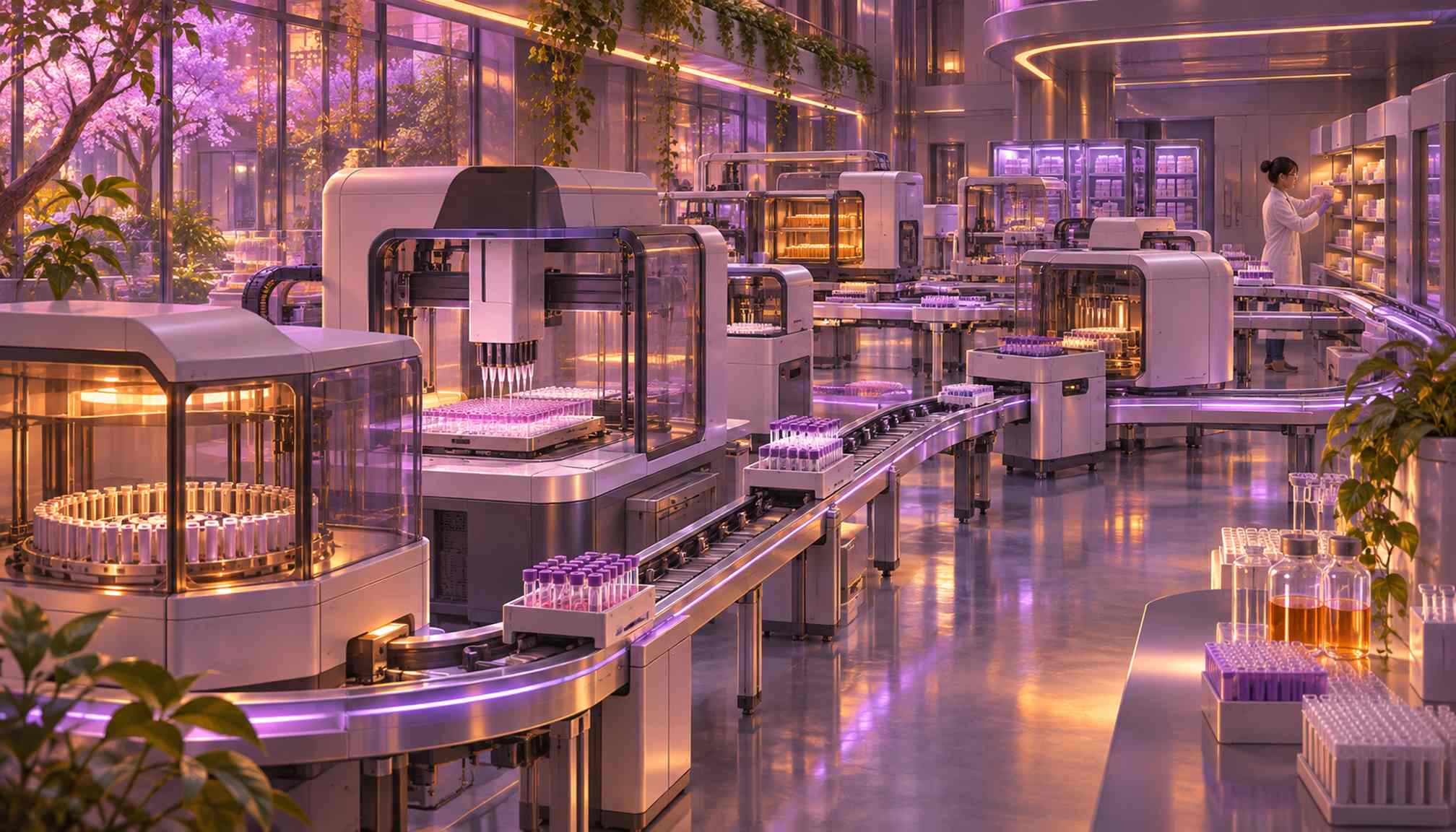

An AI-controlled laboratory has coordinated more than 20 types of instruments through over 11,000 experimental steps, demonstrating how software agents can carry molecular-biology tasks from instructions to physical results.
The system, AutoDNA, integrates AI models, experimental procedures and laboratory equipment to handle nucleic acid synthesis, transcription, amplification and sequencing.
Across four demonstrations, AutoDNA matched expert-optimized enzymatic DNA synthesis yields and accelerated concurrent protocol execution by a factor of 3.2. It also stored digital information in DNA and recovered the content exactly.
Another demonstration identified and validated a clinically detected KRAS G13D mutation. That result demonstrates an experimental workflow; it does not establish a broadly validated clinical diagnostic service.
AutoDNA joins research on robotic laboratories for materials discovery and autonomous biological experimentation, extending the approach across diverse instruments and tasks.
People remained necessary for maintenance, including replenishing reagents and labware. The achievement therefore concerns coordinated experimental execution within an engineered laboratory, rather than a facility operating indefinitely without human support.
The researchers have released code and supporting data, giving other teams material to examine the system and explore whether its approach transfers elsewhere.