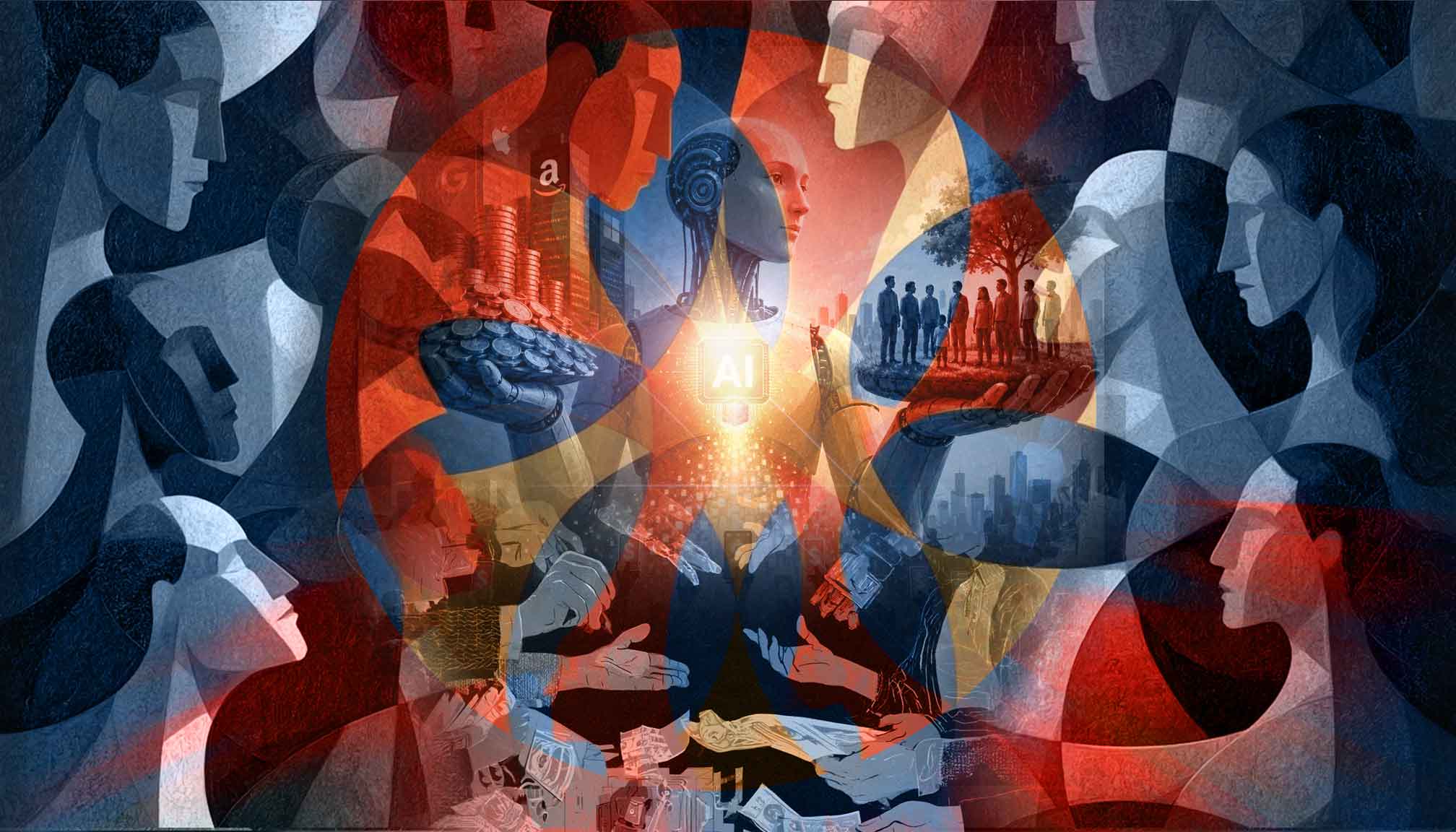

In “America’s optimistic moment and its fragile future”, I worried that political polarization could destroy our ability to build a better future. In “The need for a big-tent accelerationist movement”, I argued that technological ambition and concern for people belong together. And in my thoughts on the technoprogressive option, I explored some possible common ground, and some disagreements.
Now I want to leave long-term and metaphysical issues aside and think about practical solutions for today. How can people pay their bills, do useful work, and retain some control over their lives as artificial intelligence (AI) changes the economy?
I remain a pragmatic libertarian at heart. I distrust concentrated power, whether held by corporations or governments. But freedom without the resources to exercise it is not enough. I think universal basic income and worker-owned cooperatives could help bring these concerns together.
A basic income, not permission to survive
I think AI will make more traditional jobs obsolete than it creates. This is my expectation, not an established fact. New occupations will emerge, and nobody knows the final balance. But I would not base social policy on the hope that everyone displaced will find another decent job quickly enough. This is why I think UBI will be needed, rather than only emergency help after someone loses a job.
Universal basic income (UBI) means a regular cash payment to everyone in a defined community, normally on an individual basis, without an income test or a work requirement. A person who earns more keeps receiving it, although taxes can recover more from higher earners. It is a starting point, not a salary, and not a reward for behaving as an official wishes.
Andrew Yang’s Freedom Dividend proposal put a concrete figure on the idea: $1,000 a month for adult U.S. citizens. It was a proposal, not an enacted national program.
There are also experiments to learn from. Finland’s experiment paid 2,000 unemployed people €560 a month during 2017-2018, regardless of whether they found work. Employment effects were small, while survey respondents receiving the payment reported better well-being and economic security.
Stockton’s SEED demonstration gave 125 residents $500 a month for two years, starting in 2019. Its first-year findings included an increase in full-time employment greater than that in the comparison group. But we should not select only encouraging results. OpenResearch’s larger study, a basic income experiment in Texas and Illinois from 2020 to 2023, gave 1,000 low-income adults $1,000 a month for three years, with no conditions, while a control group of 2,000 people received only $50 a month. Both groups found more work over the three years, but those who got $1,000 found a little less. On average, they worked 1.3 fewer hours a week in paid jobs and were 2 percentage points less likely to be employed. This is a small effect, and the study suggests that many recipients used the extra freedom to look for better jobs, pursue education or training, or spend more time with their children. Still, it shows that basic income does have some effect on paid work, and honest advocates should say so.
These were limited trials, not permanent universal systems. Nor is Alaska’s annual Permanent Fund Dividend a full living income. But Alaska offers a different example: investment earnings from a fund built partly from mineral royalties support payments to eligible residents. Shared wealth can produce an individual dividend.
Senator Bernie Sanders wants to apply the same idea to AI. He introduced the American AI Sovereign Wealth Fund Act, which would give the public 50% ownership of the largest AI companies. I like the principle that everyone should own a piece of the machines that may take their jobs, and Sanders notes that OpenAI and Anthropic have floated similar public wealth funds. But I don't trust bureaucrats much, and I very much doubt that the money would really reach the public. History suggests that big pots of public money tend to shrink on their way to the people they are meant for, through administrative costs, political favors, and other leaks that nobody quite planned. Still, Sanders asks the right question: who will own the wealth that AI creates?
None of this settles national funding, prices, or long-term incentives. I would explore taxes on the wealth generated by automation and returns from shared assets, without pretending the money is free. I would also protect disability support and other essential services. UBI should increase freedom, not disguise a cut in help for people with greater needs.
Working for ourselves, together
UBI is not the same as asking everyone to stop working. I want people to have more choices about work, including the choice to work for themselves, together with others.
A worker-owned cooperative, or coop, is a business owned and democratically controlled by its worker-members. They can choose managers and divide responsibilities without handing ultimate control to outside shareholders. The Mondragon cooperative group in Spain’s Basque Country provides a real example. Its principles include one person, one vote on major decisions and a subordinate role for capital.
In Chapter 7 of "Futurist spaceflight meditations", I discussed Kim Stanley Robinson’s novel "2312". Robinson imagines a Mondragon Accord linking space settlements through a network of cooperatives that support one another. Advanced computers and AI help coordinate this economy beyond ordinary markets.
In the same chapter, I recalled that the real Mondragon system was pioneered by José María Arizmendiarrieta, a Catholic priest, whose thought is studied in Joxe Azurmendi’s "El hombre cooperativo". In his later novel "The Ministry for the Future", Robinson describes the real Mondragon as “an alternative to capitalism, more humane, what you might even call a Catholic political economy.” I find this a useful way to look at coops: a more humane form of economy with roots in a religious and moral tradition, not only in the political Left. But, as Tom Bell points out in "Your Next Government?", Mondragon is not only a moral project. It is a very successful worker-owned business that thrives because it “aligns the incentives of the workers with those of the business as a whole.” Solidarity and good incentives can work together.
What appealed to me was decentralized collaboration and ownership, not a new central authority telling everyone what to do. I also noted that early space settlements would probably reproduce familiar government and corporate structures. Science fiction offers possibilities, not guarantees. But we do not need to wait for settlements around the solar system to try cooperative arrangements here.
Two useful references are Nathan Schneider’s "Everything for Everyone", which explores cooperative ownership across different parts of the economy, and William Foote Whyte and Kathleen King Whyte’s "Making Mondragon". These are starting points for understanding an existing tradition, not instructions for a perfect society.
Of course, sharing ownership does not make disagreements disappear. I would want clear rules about joining and leaving, pay, responsibilities, and how members remove managers who fail them. Democracy should mean real control, not spending every afternoon in a meeting. A cooperative can hire experts and delegate decisions while keeping its leaders accountable to the people whose work sustains the business.
I see no reason why coops must belong exclusively to the Left. Worker ownership can appeal to socialists, but also to libertarians who prefer voluntary association, conservatives who value responsibility, and anyone who wants a fair share of what they help create. Let different business models compete.

When skills matter more than startup capital
AI could make this option more practical. In some activities, it lets a small team do work that previously required much larger resources. The challenge can shift, partly, from obtaining capital to developing skills, judgment, and the ability to work together.
AI-assisted filmmaking offers a useful example. In my article about "Cully Hill Boys", I discussed a 110-minute feature made with a reported budget of $2 million by a 28-person team in about four weeks.
I could notice signs of AI generation when looking carefully, but I wondered whether I would have noticed them as a casual viewer. More importantly, I watched the whole film because I found it interesting and entertaining. The human contribution, including the screenplay and creative decisions, remained central. The released workflow also offered something others could study and build upon.
Two million dollars is not pocket money, and this film does not prove that anyone can make a successful feature without funding. But I think it shows a direction. A small cooperative of writers, visual artists, editors, and sound designers could use AI to produce a high quality film with its own resources.
"Cully Hill Boys" was made by Higgsfield, an AI video company, to show what its tools can do. Earlier this year Higgsfield also made "Hell Grind", a 95-minute action fantasy shown at the Cannes film market in May. According to Screen International, the company says the film cost under $500,000, mostly for computing, and was made by a team of 15 directors, cinematographers and editors in about two weeks of production, although the filmmakers had developed the idea and the script over several years. Higgsfield’s CEO, Alex Mashrabov, estimated that a comparable traditional film could cost around $50 million. These are the company’s own figures for a showcase project, so I take them with some caution.
Still, the tools are clearly designed to do work that used to need a large crew. Higgsfield’s Cinema Studio 4.0, released in October, lets a filmmaker choose the camera, lens, lighting, color grading and camera moves, direct the emotions of AI actors, and keep the same characters, locations and props across shots by saving them as reusable references. Each generation can produce a scene of up to 30 seconds, with sound. This does not make filmmaking easy. Mashrabov himself said that some shots still need hundreds of attempts. The first 25 minutes of "Hell Grind" took 16,181 generations to get 253 final shots. But the main costs shift from large crews, sets and equipment to the skill, patience and taste of a small team. That is the kind of shift that favors people with talent over people with capital.
They would still need equipment, software, time, and money to live while working. They would still need an audience. AI does not remove these problems. But reducing the amount of capital required could let more teams start without borrowing money they must repay or selling ownership and control to investors. Those are different financial arrangements, and neither is necessarily bad. I simply want people to have alternatives.
I would not confuse access to an AI tool with independence either. If a team depends entirely on one provider, it remains vulnerable to that provider’s prices and conditions. I would favor shared training, tools that can be replaced, and cooperation between small businesses. This would not abolish dependence on larger infrastructures, but it could make it easier to change suppliers without losing the whole business.
A basic income would strengthen this possibility by covering part of the members’ living costs while they develop a project. UBI and cooperative ownership could reinforce each other: one provides security, the other offers a way to create and share additional income.
Keep the platform, change the ownership
Uber already offers a way to earn through a platform rather than seek a conventional job. A driver still needs access to a vehicle and must meet requirements, but does not have to build a booking system from scratch.
However, flexibility is not ownership. Uber has shareholders and corporate governance, not worker-member control. I would like more platforms where the people doing the work also own the system connecting them to customers. AI could help small teams build and run such systems, though attracting customers and earning trust would remain difficult.
I am not proposing to prohibit investor-owned platforms. I am proposing to make room for alternatives that workers can choose freely.
Public support without public command
Some useful work cannot depend only on customers who can pay. Consider home assistance for older people, people with disabilities, or others who need help but lack resources. I think governments could and should fund cooperatives providing such services.
This is not entirely hypothetical. New York’s Cooperative Home Care Associates describes itself as worker-owned and provides Medicaid-supported home care. Public funding and worker ownership can coexist.
I would explore startup grants, training support, and fairly paid service contracts for independent care coops. Worker-owners would organize the work and choose their management. The person receiving help should also have a voice and a clear way to complain or change providers.
Here AI could make a big difference, and I want to emphasize this point. Ask any caregiver, nurse, or social worker, and you will hear the same complaint: too much of the working day goes to forms, reports, schedules, billing, and compliance records, and too little to the people who need help. In a traditional organization, this burden is handled by managers and office staff, which is one reason why small independent providers find it so hard to compete. AI assistants are already good at exactly this kind of work. They can plan visits and routes, fill in forms, keep records, prepare invoices, and answer routine questions. A small care coop with a good AI back office could run with almost no administrative overhead, and the worker-owners could spend their time with the people they serve. This is the same shift I described earlier, from capital to skills: the office work that once required money and staff can be done by software, while the human part of care, which is listening, comforting, and paying attention, stays human. AI should take the paperwork, not the people. In this way, AI would not replace care workers. It would give them back the time to do what they chose this work for.
The funding must also be realistic. I do not want a government to praise worker ownership while paying so little that the worker-owners remain poor. Nor should every unemployed person be pushed into care work, which requires ability, patience, and training. I am proposing one useful option among many. The aim is to connect people who want to provide a service with people who need it, even when those needing it cannot pay.
I would rather put operational control in the hands of the worker-owners of care coops than in an inefficient or corrupt bureaucracy. But a coop is not automatically efficient or honest either. Public money requires transparent accounts, independent checks, care standards, and consequences for abuse. Government should ensure that help reaches people, not manage every working day.
To me, this could be a practical stepping stone toward UBI: public wealth supporting people while giving them more control. But paid cooperative work is not unconditional income, and must not become a work requirement for basic security. People unable to work must not be excluded.
There is a practical political distinction here. Supporting a local care cooperative does not require agreement about the whole future of capitalism. People can disagree about that and still agree that a neighbor needs help, a caregiver deserves decent pay, and neither should be powerless. I would rather begin with such agreements than wait for everyone to adopt the same ideology.
Start with useful services, test different arrangements, publish the results, and improve what works. Alongside this, develop the funding and political support for a genuine basic income. The Left can see solidarity and worker power here. The Right can see enterprise, responsibility, and less centralized management. I can see both. That seems a reasonable place to begin building the big tent.