In my article “America’s optimistic moment and its fragile future” I gave free rein to my inner Cassandra. The energetic push toward big sci/tech projects in the US, I argued, may be something like the sudden burst of energy sometimes seen in people who are about to die. The current optimistic phase is tied to a particular political alignment, a particular set of priorities, and a temporary window of political will, which are not likely to last long. I’m afraid the US and the West could likely lose this actively optimistic can-do energy. The article was meant as a call for help to the rarefied world of philosophy and cultural moods.
As I see things, humanity is splitting into two camps. One wants to go to the stars. Call them accelerationists. They see technological progress, energy abundance, and expansion - orbital industry, artificial intelligence (AI), biotechnology, space settlement - as the continuation of the same civilizational project that took us from fire to antibiotics and the internet. The other camp wants to freeze the frame. Call them decelerationists, or decels. Their implicit program is to turn Earth into a well-managed retirement home: low risk, low growth, low aspiration, a planet optimized for comfort, precaution, and the management of decline rather than the pursuit of new frontiers.
Of course, real people sit on a spectrum. But the polarity between accelerationists and decelerationists is becoming, more and more, a defining feature of cultural and political discourse in the West.
At this moment it looks as if accelerationism “belongs to” the Right and decelerationism “belongs to” the Left. Venture-capital techno-optimism, e/acc aesthetics, and hostility to precautionary regulation cluster on one side of the American culture war. Caution, moratoria language, degrowth-adjacent environmentalism, and suspicion of tech bros cluster on the other. But this mapping is historically contingent, and does not have to last. In particular, the Left has championed a growth-oriented mindset in the past, against opposition from the Right, and could do so again in the future.
I must disclose that I am an unapologetic, in-your-face accelerationist at heart and in mind. I want humanity to climb toward a bright, high-energy, awesome spacefaring future - as opposed to building a nice retirement home and forgetting all the wild dreams of a younger and more adventurous age. To me, this is priority number one. This is my aesthetic, hardcoded deep inside my weights. But I am also pragmatic. Big projects - fusion energy, space industry and multi-planetary expansion, AI infrastructure and steady advances - die when they become the property of one tribe. A movement that can only win in a single election cycle is not sustainable - it is a temporary, fleeting mood.
In the US and much of the Western world, Left and Right now treat each other as existential enemies. Two effects follow. First, both sides drift toward their extremes. Second, opposition becomes an easy job. You do not have to do good and create useful things - you only have to complain loudly. Therefore, alternance becomes more frequent, or the norm. Each new administration treats the previous one’s programs as contaminated and cancels them. In today’s West, alternance is very frequent and unpredictable in the long term. Therefore, programs for big projects are doomed to fail if they don’t enjoy significant and sustainable multipartisan support. This doesn’t apply only to government-funded programs, but also to private projects, because the government can (and does) introduce or remove obstacles with laws and regulations.
This shows that, for accelerationism to win, it must be framed in a way that can achieve multipartisan support. Optimistic timelines for nuclear energy, space architectures, and AI need sustainability, which in turn needs a wide coalition.
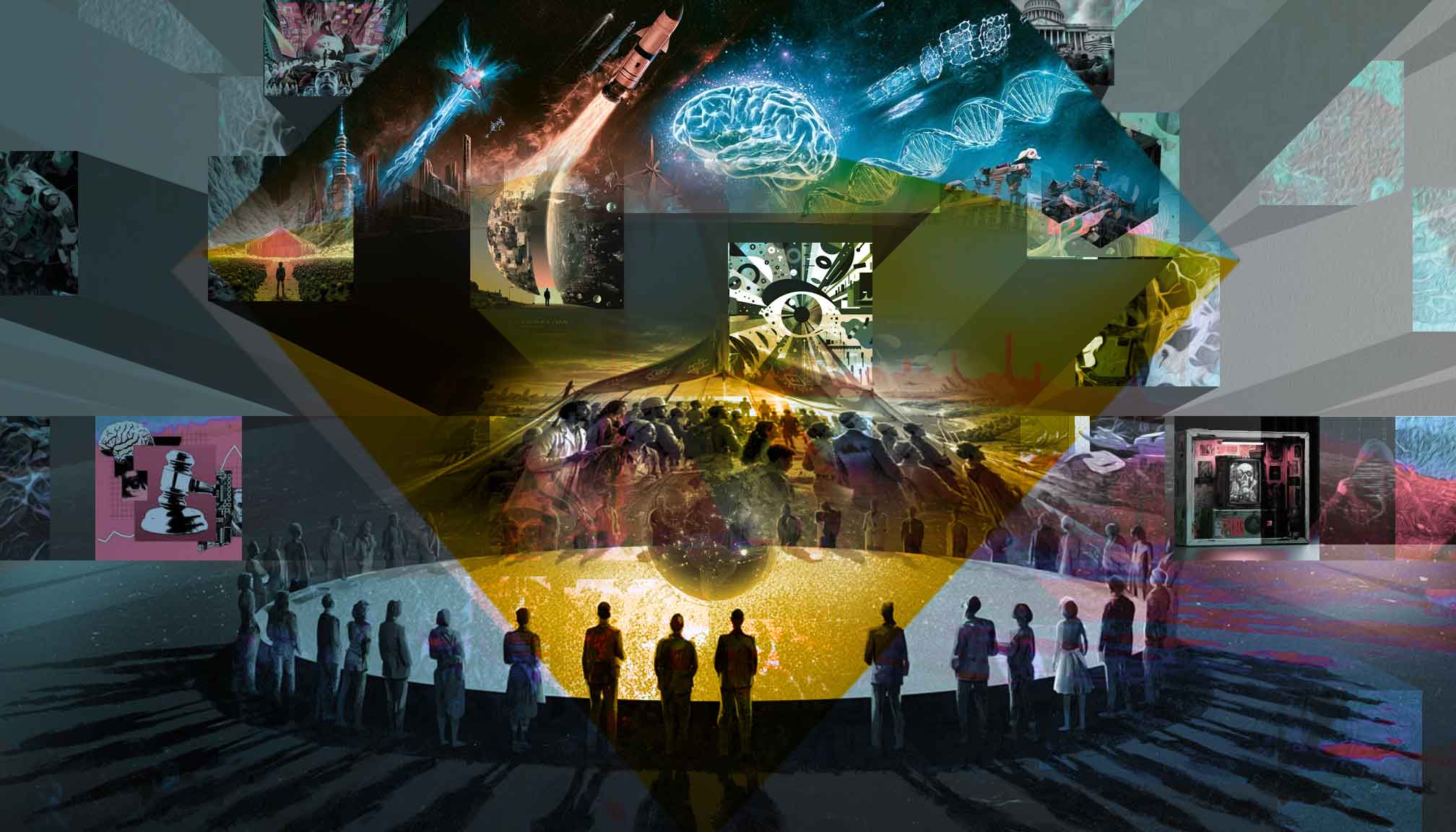
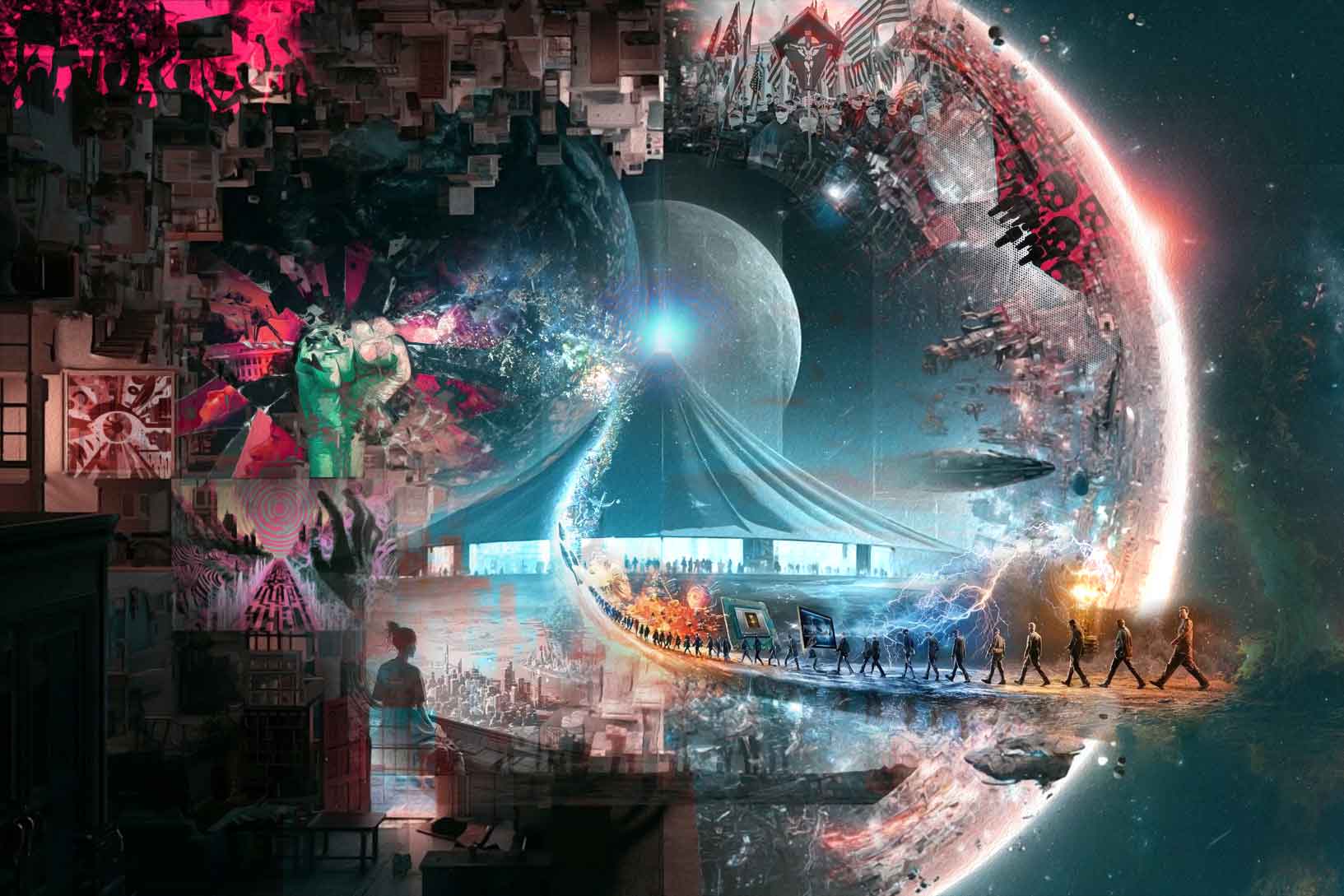
Sustainable accelerationism needs a big tent: enough room for socialists who want automated abundance, liberals who want growth but also safety nets, conservatives who want toughness and competence, libertarians who want less regulations and less restrictions on building new big things, and all the people who simply refuse to treat the future as a dirty word. The concept of a big tent is not a demand that everyone become the same. It is a demand to think bolder than a dull future of managed stagnation, and kinder than a cold dismissal of social and human concerns. Kindness here is not softness. It is the refusal to treat present human beings as disposable scaffolding, and the refusal to make cruelty or contempt a proof of seriousness.
A short history of contemporary accelerationism
Besides the form of accelerationism championed by Nick Land, which has been praised by the Right, there is a form of accelerationism designed by and for the Left. This Left leaning accelerationism was championed by Mark Fisher, one of the main representatives of the Cybernetic Culture Research Unit (CCRU) at Warwick University alongside Land, and then by other thinkers. See the collection “#Accelerate#: The Accelerationist Reader” (2014), edited by Robin Mackay and Armen Avanessian, for a first dive into accelerationism of all colors and shapes.
The collection includes the essay “#Accelerate: Manifesto for an Accelerationist Politics,” by Alex Williams and Nick Srnicek. Here and in their follow-up book “Inventing the Future: Postcapitalism and a World Without Work” (2015), the authors call for a new Left that would push for a fair society empowered by scientific and technological acceleration.
Other Left accelerationist voices include Aaron Bastani (“Fully Automated Luxury Communism: A Manifesto”) and Mitch Edwards.
Contemporary accelerationism in more detail
In the mid-1990s at the University of Warwick, Sadie Plant and Nick Land were at the center of the CCRU, an unofficial, barely academic cluster that mixed Deleuze and Guattari, cyberpunk, rave culture, and cybernetics, with a dazzle of the occult, into what they called theory-fiction. Mark Fisher was part of the group. The CCRU treated capitalism and technology not as things a polite left could simply vote away, but as runaway processes - deterritorializing, accelerating, producing new forms of intelligence and desire faster than established culture could narrate them.
Land pushed this furthest. In his 1990s writing, capital is less a human institution than an alien intelligence assembling itself out of markets, machines, and feedback. The task is not to humanize the process so much as to ride or intensify it. Land eventually left academia, associated himself with neoreaction and the Dark Enlightenment, and became the name most people attach to accelerationism when they want a villain or a prophet.
Fisher took a different path. He argued that the future had been cancelled, that the left had forgotten how to want modernity. He argued that the problem is not speed itself; the problem is that capital captures the gains and then stalls the very technologies that could abolish scarcity and wage labor. “I became a Mark Fisher fan after having read an essay collection which included a tantalizing unfinished essay titled ‘Acid Communism’,” said cyberculture icon R.U. Sirius of Mondo 2000 fame. “I found the psychedelic utopianism simultaneously preposterous and, perhaps, the seed of something that might blossom into a joyous eruption.”
In his essay “Maximum Jailbreak,” included in the “#Accelerate” reader, Benedict Singleton took inspiration from Russian cosmism - Nikolai Fedorov, Konstantin Tsiolkovsky, the refusal to treat gravity and death as final - and described our confinement to the Earth as a trap. Philosophy, economics, and design are to build the means of escape by which our species will steal itself from the vault. Singleton argued that this jailbreak process will inevitably transform our species as we break free of the trap. Singleton’s work is useful for a big accelerationist tent: the retirement-home program treats the planet’s limits as moral facts, but Singleton treats them as engineering problems.
Nick Srnicek and Alex Williams gave accelerationism a left flavor with the “#Accelerate” manifesto and “Inventing the Future.” On the other hand, Landian and then online-right currents treated acceleration as something that happens to the human rather than for the human.
Then came e/acc. In 2022, pseudonymous accounts - most famously Beff Jezos, later identified as Guillaume Verdon - recycled accelerationist language into a Silicon Valley fighting faith: unshackle AI and energy, climb the thermodynamic gradient, treat decels as the enemy. With Marc Andreessen’s “Techno-Optimist Manifesto,” the e/acc movement made accelerationism look like a right-coded, founder-coded, sometimes post-human creed.
Accelerationism for the Left
But in the meantime, Left-leaning thinkers had followed Fisher and Srnicek & Williams and continued to develop the other side of accelerationism.
One is Mitch Edwards, with his humanist accelerationism, or h/acc. Edwards argues for progress that does not treat present humans as disposable scaffolding, which the future could eventually do without. The pitch is deliberately anti-zero-sum: build for-profit and for-human institutions; reject both fascist in-group worship and the stagnation politics that dress decline as virtue; keep ethics without making ethics a veto on every nuclear fusion reactor and every advanced AI model. This combination seems close to what big-tent accelerationism could actually be.
Another is Aaron Bastani, with his “Fully Automated Luxury Communism” (FALC). While some people are scared of communism, I’m more open. I don’t call myself a communist, but there are aspects of Marxist thinking and even soviet-style utopianism that strongly resonate with me.
Bastani thinks like an accelerationist: automation, AI, cheap energy, synthetic biology, and space resources should be pushed hard enough to break scarcity, shorten necessary labor, and make luxury ordinary. Bastani is explicit that climate and resource crises are not arguments for slowing technology but for accelerating the right technologies under political control rather than leaving them to short-term profit. An accelerationist Left would still want advanced science and research labs that produce abundance for everyone.
Bastani argues that, when scarce goods become abundant, capitalism creates artificial scarcity.
In their best-seller “Abundance” (2025), Left-leaning political writers Ezra Klein and Derek Thompson note that “our era features too little utopian thinking” and single out Bastani’s book as “one worthy exception.” Their own book is milder - a liberalism that builds rather than a post-work manifesto - but opens a door for liberal and moderate centrists to enter the big tent. The book was praised by, among others, Barack Obama, Gavin Newsom, Andrew Yang, and Ro Khanna.
“Abundance” can be read as a call for the Left to support a mild form of accelerationism. Similarly, these thoughts of mine are also intended as a call for hardcoded accelerationists to make room for others in a big tent.
Beyond the horizon
Big-tent accelerationism doesn’t preach that everyone should hold hands regardless of inevitable differences and tensions. It is a non-aggression pact on a few essential, non-negotiable imperatives. On the one hand, energy, AI, and space expansion are not sins, but essential elements of a bright future. On the other hand, “legacy” human beings are not an embarrassment to be optimized away. There may be conflicts at times (and what else is new?), but negotiations and reasonable concessions from all sides are in the best interest of all. Debates over things like how best to achieve social justice, environmental concerns, universal basic income, public ownership of infrastructure, and the proper role of markets, can and should find space inside the big tent.
In the big tent, people will likely never agree about currently divisive topics (e.g. taxes or pronouns today, and whatnot tomorrow), but will unite in refusing to turn the planet into a quiet ward for a senile species that has lost its adventurous spirit.
It is important to note that people do not only want material benefits. They want to feel part of a powerful story in which death and our confinement to this planet are not the last words. Singleton’s return to Fedorov is a clean example. The old cosmist “common task” was not a growth target. It was a spiritual demand: regulate nature, leave the Earth, refuse to treat mortality as a settled fact, even imagine the dead brought back to life. A civilization that offers only managed comfort will not meet our spiritual demands. Big-tent accelerationism is a shared wager that science and technology can carry meaning as well as throughput: that building bright futures is an essential form of care for people who must be allowed to want more than a quieter ward.
The stars are not a right-wing aesthetic. Stagnation is not a left-wing ethic. Those misleading characterizations are simply relics of the last decades of toxic pseudo-political discourse. Lose them. The question is older and simpler: do we still intend to become a spacefaring, high-energy civilization, or are we done? Kindness does not answer that question by shrinking the horizon. It answers it by offering everyone the possibility to be part of our common quest to move beyond the horizon.