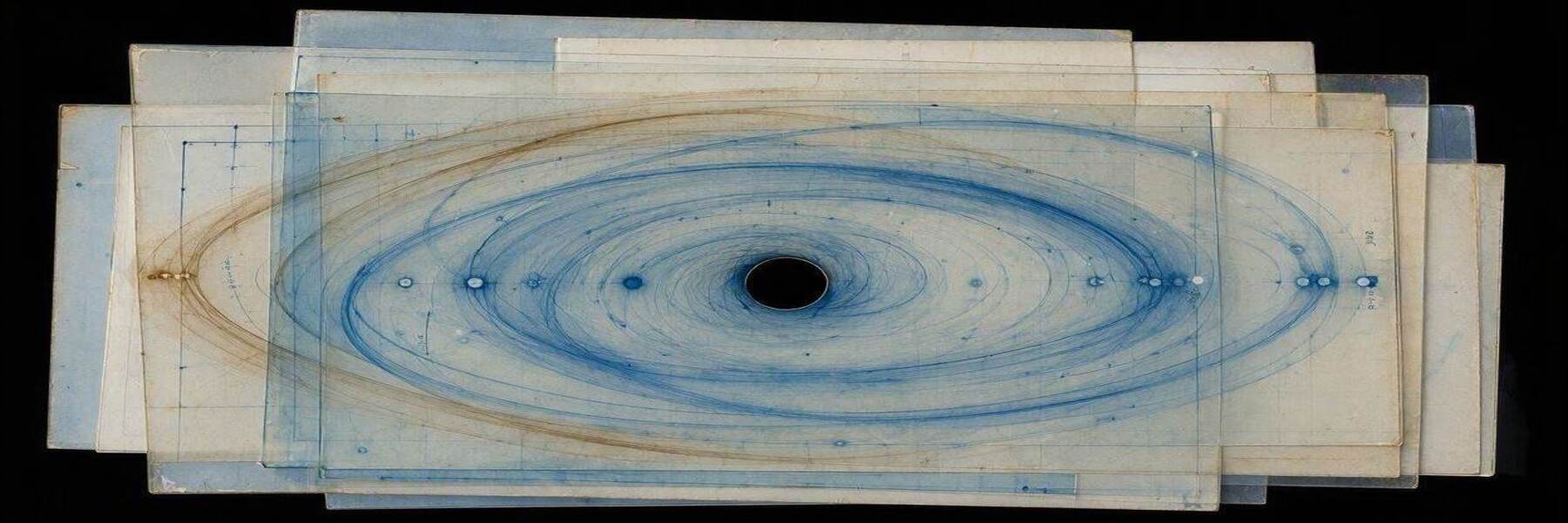

A faint star whipping around the Milky Way's central black hole at 25,000 kilometers per second, roughly 8 percent of the speed of light, could let astronomers directly measure how fast that black hole spins, a fundamental property that has eluded direct detection for decades.
The star, designated S301, orbits Sagittarius A* on an 8.7-year ellipse that brings it within 1.7 billion kilometers of the event horizon, about the distance from the sun to Saturn. A team led by Felix Mang and Stefan Gillessen at the Max Planck Institute for Extraterrestrial Physics spotted S301 using the European Southern Observatory's Very Large Telescope Interferometer and confirmed its orbit with observations stretching back to 2017. Their findings appear in Nature.
Previous attempts to gauge black hole spin relied on indirect proxies, modeling X-rays from swirling gas or interpreting gravitational wave mergers, and those approaches have left room for debate. S301 offers something different. Its orbit is tight enough that frame-dragging, the general relativistic prediction that a spinning black hole twists spacetime around it, should visibly warp the star's trajectory over years of observation. The technique parallels how laboratory systems have begun recreating black hole physics to probe gravity under controlled conditions.
What researchers still need is time. Detecting the spin signature will require years of precise tracking, likely with next-generation extremely large telescopes. Even then, the measurement will put Einstein's theory to its most extreme gravitational test, and questions about what happens to energy near a spinning black hole will only sharpen.