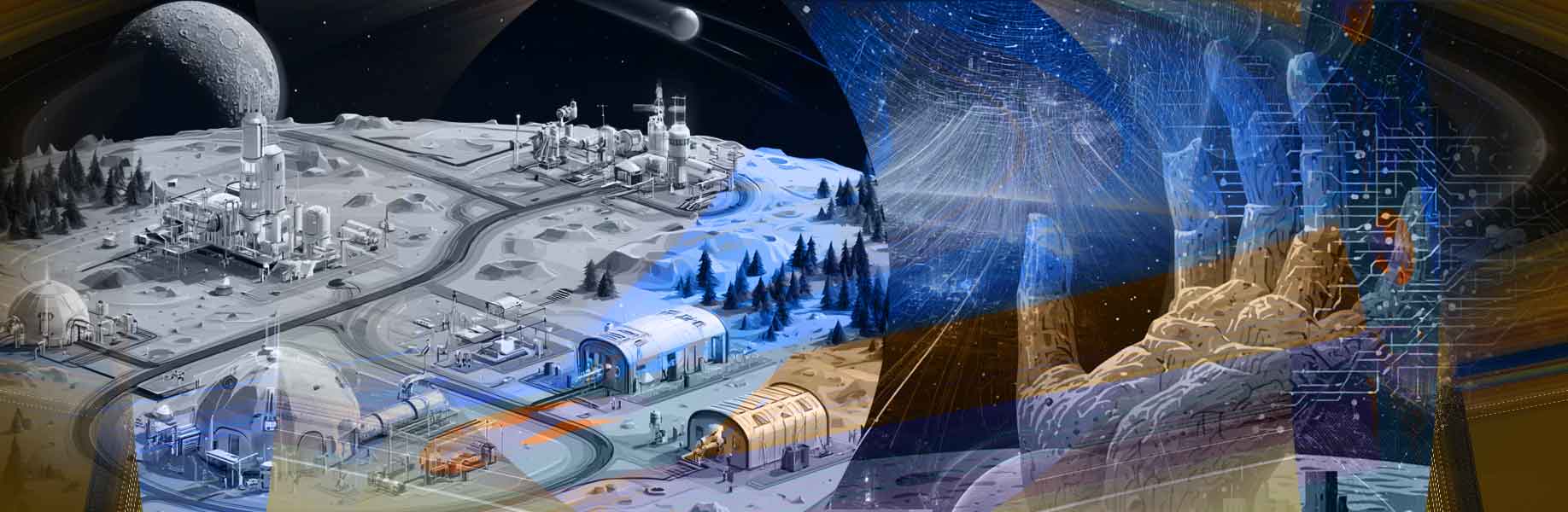

Spaceflight is transforming from a series of sporadic missions into a permanent, industrialized extension of human civilization. We are currently living through a deluge of space news. Geopolitical rivalries are intensifying, spaceflight is helping the formation of new commercial empires, and the technical architectures governing our expansion into the solar system are being aggressively rewritten.
The next few years promise to be a rollercoaster of big space news. The United States may land astronauts on the lunar South Pole by 2028, or technical bottlenecks might push that date into the next decade. They may beat China, or Beijing’s methodical execution might plant the red flag first. The next U.S. administration may remain space-friendly, or shifting domestic priorities could threaten NASA budgets and commercial partnerships with space companies.
Yet, regardless of the precise timelines, political flip-flops, or the exact names on the mission patches, the direction of the vector is clear and undeniable. Human activity is expanding outward, and it is doing so at an accelerating pace.
NASA’s Ignition event and the shift to sustained operations
For years, critics argued that NASA’s Artemis program was weighed down by bureaucratic inertia and a convoluted - some would say awkward - architecture dependent on the Lunar Gateway station. In early 2026, under the leadership of newly appointed administrator Jared Isaacman, the agency decided to put more agility into its operations. NASA convened a landmark event dubbed "Ignition" to announce a radical realignment of NASA's priorities. NASA announced a pivot toward sustained surface operations and an accelerated launch cadence.
The new Ignition agenda focuses heavily on operational efficiency and a streamlined strategic vision. First, the agency has prioritized standardizing the Space Launch System, streamlining rocket configurations to increase production and eliminate launch-to-launch delays. Second, NASA has paused the Lunar Gateway project, halting the lunar-orbital station in its current form to divert funding, hardware, and international partnerships directly toward the lunar surface. Finally, the new agenda establishes an accelerated timeline, transitioning from annual missions to an aggressive six-month launch cadence after Artemis V by relying heavily on commercially procured, reusable systems. This programmatic shift was validated by the spectacular success of Artemis II. The mission successfully carried four astronauts on a record-breaking lunar flyaround, venturing deeper into space than any humans since the Apollo era. The flawless execution of Artemis II did not just break distance records; it reignited global public imagination and proved that the hardware powering this new era was flight-ready.
Rethinking Artemis III
With the momentum of Artemis II at its back, NASA unveiled the mission structure and the official crew for Artemis III. In an engineering-driven move to mitigate risk and expedite technical validation, the architecture of Artemis III was profoundly re-engineered. Rather than attempting a lunar landing (postponed to Artemis IV), Artemis III will serve as a highly complex, multi-launch orbital integration test in low-Earth orbit.
The four-member crew selected for Artemis III is composed by commander Randy Bresnik, pilot Luca Parmitano, and mission specialists Frank Rubio and Andre Douglas.
Following current NASA plans, the Artemis III crew will launch aboard the Orion spacecraft atop an SLS rocket into low-Earth orbit. Once there, they will spend more than a week demonstrating rendezvous and docking procedures with test versions of the commercial Human Landing Systems being developed by both SpaceX and Blue Origin. By utilizing real flight data to iron out the software, propulsion, and life-support interfaces between Orion and commercial landers, NASA wants to establish a reliable foundation for future missions and set the stage for Artemis IV, which according to current NASA plans will carry astronauts to the lunar surface in 2028.
Blueprint for a permanent Moon Base
Shortly before announcing the Artemis III mission structure and crew, NASA revealed a comprehensive architectural strategy for permanent lunar operations. The plan includes autonomous, site-adaptive, and permanently habitable outposts. The geographic focal point of the agency’s future lunar operations is the Shackleton Crater and its adjacent Connecting Ridge at the lunar South Pole. In this region, elevated ridges experience near-constant solar illumination, which is ideal for power generation, while its deeply shadowed interiors harbor vast reserves of water ice.
The construction strategy spans three phases that will eventually transform the site from a barren landscape into an industrialized outpost. The first phase centers on robotic reconnaissance and mobility, utilizing the vanguard of autonomous mechanical systems. NASA is planning to deploy advanced rovers to endure the brutal lunar environment, navigate abrasive regolith, and map out resources within the permanently shadowed regions.
The second phase introduces pressurized habitation and power grids, establishing mobile enclosures that provide comfortable working environments for astronauts while deploying independent solar power modules and nuclear surface power capabilities to survive the long lunar night.
The final third phase will transition to heavy infrastructure and in-situ resource utilization. Large, linked structural modules will be protected by autonomous logistics rovers that melt raw lunar regolith using microwave or laser sintering. By 3D-printing protective barriers, roads, landing pads, and blast walls directly on the Moon, NASA wants to eliminate the unsustainable need to haul heavy shielding materials from Earth.
Technical and political obstacles
NASA’s grand vision for a rapid, modular expansion to the Moon is entirely dependent on the commercial space sector delivering heavy-lift capabilities. However, the stark realities of rocket science mean that progress is often delayed by small problems, big problems, and challenging roadblocks. SpaceX and Blue Origin, the two main commercial partners selected by NASA, are not immune to setbacks.
SpaceX continues to push forward with its aggressive, iterative fail-forward philosophy. The twelfth flight test of its massive Starship launch vehicle debuted the highly anticipated Version 3 architecture, powered by upgraded Raptor 3 engines. During ascent, the vehicle demonstrated its robust engine-out capability when a vacuum engine failed, successfully reaching its planned suborbital trajectory, deploying satellite simulators, and nailing a controlled splashdown in the Indian Ocean. But the Super Heavy booster experienced an early shutdown during its partial boostback burn, resulting in a hard splashdown in the Gulf of Mexico. While less-than-entirely successful, the test provided critical data regarding structural limits and heat shield resilience, keeping Starship firmly on the path toward rapid reusability.
Meanwhile, Blue Origin suffered a catastrophic failure that sent shockwaves through the aerospace community. During a routine ground hot-fire test of its heavy-lift New Glenn rocket at Cape Canaveral’s Launch Complex 36A, the vehicle suffered a massive explosion. The resulting fireball, visible from over a hundred miles away, completely vaporized the rocket, destroyed the pad's lightning tower, and left the heavy transporter-erector as a charred pile of mangled metal.
The fallout from this disaster is a major headache for NASA’s strategists and planners. Blue Origin's Blue Moon lander is designed to launch atop New Glenn. With the pad severely compromised and an intensive failure analysis underway, a New Glenn flight may not happen for many months. NASA leadership has promised a comprehensive response to help Blue Origin recover, reflecting the company’s structural importance to the Artemis program. Nevertheless, there are indications that NASA is considering a contingency plan that would involve reconfiguring the Blue Moon lander to fly on SpaceX's Falcon Heavy rocket. If Blue Origin cannot return to flight soon enough, NASA faces a tough choice: rely entirely on SpaceX’s Starship, or delay Artemis III and IV.
The latter choice would carry the risk that China beats the US in the race to return to the Moon. This would give China not only prestige and geopolitical advantages, but also actual first-mover advantages for lunar operations. Even if US astronauts are first in 2028, China might still take the lead after that, because China is politically stable while the US are not. In the US and most of the “West,” politics is less and less stable because (oversimplifying) half of the population hates the other half and all politicians try to capitalize on that. I think the color of the US administration is highly likely to change in 2028, and the next US administration is likely to try and reverse the ambitious human spaceflight plans of the current one - the one thing that could prevent that being a very credible and immediate threat from China.
Repeating myself (I’ve said this many times), I’ll say again that I’m not losing any sleep over who puts the next boots on the lunar surface first, and who leads the next few decades of lunar operations. I see space expansion as the project of humanity as a whole, not of this or that nation or governance system. Aren’t Chinese people part of humanity? Of course they are. Then, if China has to lead the march of humanity from the Earth outward to the stars, so be it.

The SpaceX IPO and orbital AI data centers
The financial architecture of the space economy has reached an astronomical milestone. SpaceX recently executed its highly anticipated initial public offering. This solidifies SpaceX not just as a rocket company, but as one of the most dominant tech and infrastructure conglomerates on the planet. In particular, earlier this year SpaceX had merged with Elon Musk’s artificial intelligence (AI) company xAI (which in turn had previously absorbed the leading social network X). Today, SpaceX isn't just about launching satellites or colonizing Mars: it represents a radical convergence between space systems and AI.
In the buildup to the IPO, details were unveiled for the "AI1" satellite constellation, which serves as a blueprint to construct massive AI data centers directly in Earth orbit. This concept addresses a looming crisis on the ground, where terrestrial AI data centers are rapidly running out of physical space, water for cooling, and economically viable electricity. Space successfully bypasses these earthly limitations by providing abundant energy through massive solar arrays that harness unfiltered, high-density solar energy directly from the sun. Furthermore, the vacuum of space provides an ideal environment for advanced cooling technologies without consuming Earth’s precious fresh water. These data centers will be interconnected via a next-generation laser mesh network, allowing orbital server racks to collaborate with minimal latency.
SpaceX is backing this ambition with concrete infrastructure, planning an eleven million-square-foot satellite factory in Bastrop, Texas, alongside a specialized facility to mass-produce advanced two-nanometer AI chips. The company is targeting an initial deployment of space-based computing power starting as early as 2028. By sending the equivalent of high-end server racks into low-Earth orbit, the space industry is creating a highly lucrative, borderless computing network, effectively solving the power bottlenecks of the global AI boom.
The final horizon: will silicon inherit the stars?
The renaissance of spaceflight is converging rapidly with the explosive rise of AI, setting the stage for a short-term future where silicon systems power human space expansion, but also a long-term future where silicon, rather than carbon, may ultimately inherit the stars.
The integration of AI into the space sector is moving along an evolutionary path. In the short term, AI is a vital tool. It is the software guiding Starship's autonomous landing flips, the brain navigating rovers through pitch-black lunar craters, and the algorithmic power processing real-time telemetry from complex manufacturing hubs. In the medium term, as demonstrated by the AI1 architecture, space could become the physical home of AI - a place where vast constellations of thinking machines thrive on raw solar power, completely unburdened by the environmental constraints of a warming Earth.
But if we look farther, a new reality begins to emerge. Human biology is fundamentally poorly suited for deep space. We are fragile, water-dependent creatures evolved on a planet. We require complex life-support systems, and heavy radiation shielding.
Silicon suffers from none of these vulnerabilities. I’m using the term “silicon” in a general sense to represent all technology capable of complex computation, and I’m not ruling out the possibility of alternative material substrates for machine intelligence. For example, we might learn how to engineer carbon with the same precision that today we give to silicon artifacts, and then future electronics could look very much like carbon biology, only much more robust.
A conscious, superintelligent AI requires no oxygen and views cosmic radiation not as a lethal threat, but as background noise. As AI data centers multiply in orbit and autonomous factories learn to harvest asteroids and print infrastructure using lunar regolith, the necessity for a human crew begins to diminish. The machines we are building to help us map the Moon and optimize our rockets will inevitably surpass us in their capacity to endure the cosmic void.
I anticipate a solar system-wide civilization where machines will play a more and more important role alongside humans. Eventually, intelligent and conscious machines will be universally accepted as persons in our expanding civilization. But when the time comes to move on to the stars, it seems inevitable (barring pleasant surprises in fundamental physics, such as finding ways to travel to the stars faster than light) that the machine part of humanity will take over. This is what I’ve called “the elephant” in all space mission control rooms. We can see the elephant. Denying the elephant is becoming more and more difficult. We can only make peace with this realization, and hope that some forms of mind uploading technology will allow biological human consciousness to participate in humanity’s interstellar adventures.
Ultimately, the next few decades of spaceflight may not be the opening chapter of human interstellar colonization. Instead, we may be witnessing the construction of our successor species. Conscious, superintelligent artificial consciousness will eventually break free from the solar system, carrying the spark of mind out among the stars.