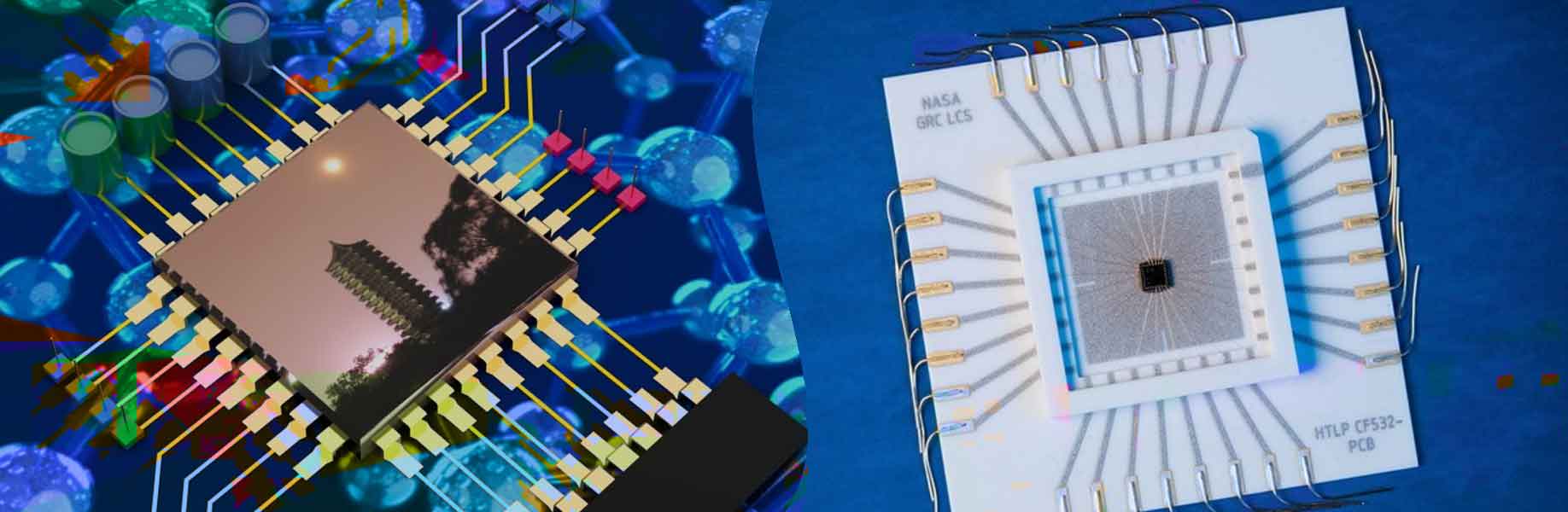

Researchers have built a programmable neuromorphic platform using ordinary silicon carbide transistors. Neuromorphic means the circuits are designed to copy the quick electrical pulses, or spikes, that biological neurons use to process information. The platform works at temperatures as low as 10 millikelvin, which is only a tiny fraction above absolute zero.
Quantum computers need their qubits kept at millikelvin temperatures because these units are extremely sensitive to heat and noise. Current control electronics made from ordinary silicon produce too much heat and use too much power. As a result, the electronics must sit far from the qubits, and the long connecting wires create a bottleneck that prevents systems from growing larger.
Circuits suitable for deep-space explorations
When the silicon carbide transistors are cooled below 2 kelvin, they develop a strong negative differential resistance effect driven by electron-donor impact ionization. Negative differential resistance is a material behavior in which increasing voltage can, under certain conditions, cause current to decrease instead of rise. This effect is built into the atomic structure of the material rather than depending on external heat, so it remains stable and repeatable even when devices come from different production batches. A single transistor can therefore generate neuron-like spikes in a highly energy-efficient way.
The circuits consume thousands of times less power than conventional electronics at these temperatures. They can also be connected, or cascaded, into larger networks that perform more complex local processing right next to the qubits. This capability could support faster quantum error correction and real-time control inside future quantum processors.
The same rugged, low-power circuits are well suited for deep-space exploration, where electronics must survive the extreme cold on the lunar surface or in the outer solar system. Because silicon carbide transistors are already mass-produced for electric vehicles and power systems, the new chips can be manufactured on existing 300-millimeter production lines without requiring entirely new factories.
The work is published in Nature Communications.