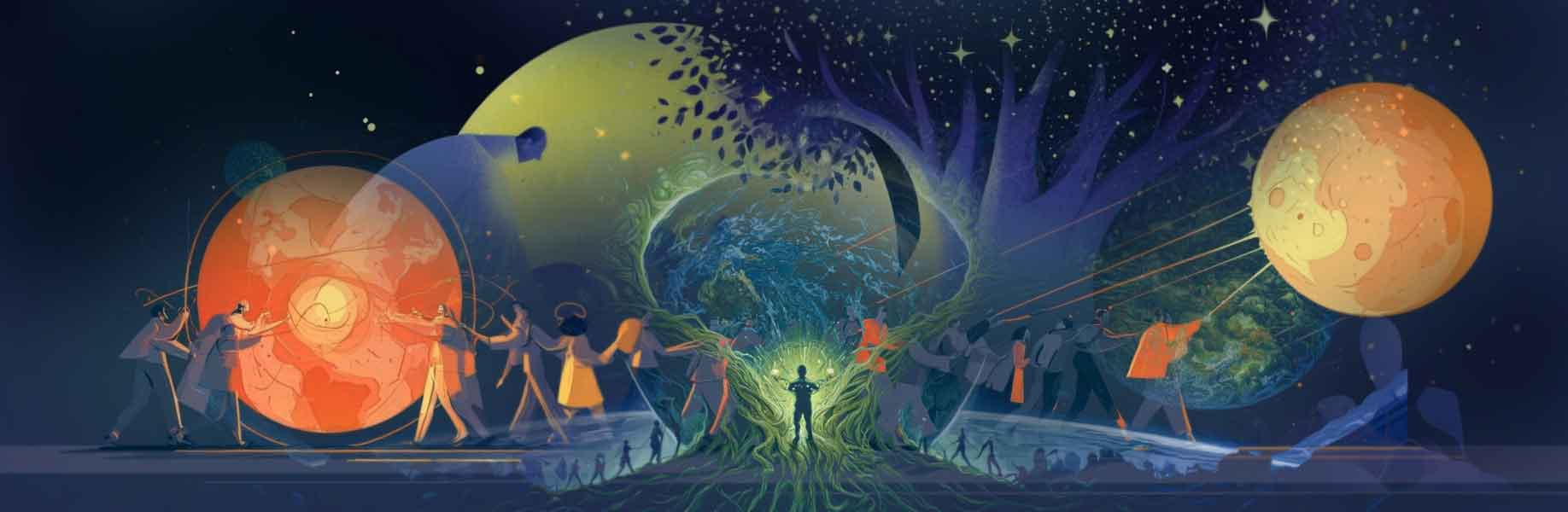

A few months ago I watched the Mindplex podcast episode “Humanity 2.0: Space - the Inner Frontier.” In the episode, hosted by Mihaela Ulieru, space visionary and entrepreneur Rick Tumlinson elaborated on the thoughts presented in his book “Why Space?: The Purpose of People” (2025).
I found the podcast episode fascinating, and rushed to read the book. I posted my first impressions in my January Mindplex article “Why we are going back to the Moon.”
Now we have been around the Moon again for the first time since the 1970s and NASA has announced plans for a permanent Moon base. This is exciting for all space enthusiasts, and I’ve been reading Tumlinson’s book again, this time more carefully and taking the time to enjoy it. I recommend this book to all space enthusiasts - it will boost your enthusiasm and help you see this new exciting phase of human spaceflight from a cosmic perspective.
I confirm the first impressions that I outlined in January, and will elaborate more at the end of this article. But first, let’s go through the book.
The book is a hybrid work: part memoir, part philosophical reflection, part manifesto and urgent call to action. It blends personal storytelling, a compact history of spaceflight in the last century and the current commercial revolution, the “standard” practical arguments for spaceflight based on economic/industrial considerations and the need to ensure the survival of humanity, the parallel needs to protect the Earth and be nicer to each other, and a spiritual/philosophical framework for why humanity must expand beyond Earth.
The book opens with a poetic preface inviting the reader to step outside, look up at the stars, and feel the “calling.” It then moves through Tumlinson’s colorful life story, a hopeful fictional dispatch from his granddaughter living on the Moon, and structured sections that build from crisis and history to the book’s core: humanity’s Purpose and the three Principles of Purpose that should guide our expansion into the cosmos.
Crisis as opportunity
Tumlinson frames the 100 years we’re living in (roughly 1935–2035) as possibly the most consequential century in the history of life in the Solar System. We face intertwined planetary crises such as climate change, inequality and technological disruption, and at the same time we have unprecedented tools to solve them - tools that, on the other hand, we could also use to destroy ourselves.
Tumlinson offers a thought experiment: pretend, for argument’s sake, that humanity is currently the only spark of sentience in the universe. In that case, our choices carry cosmic weight: preserving and expanding consciousness itself, or extinguishing the universe’s chance to know and experience itself through us. We are “the eyes, hands, and heart of the Universe,” and we must overcome extinction risks to continue to play this essential role.
This urgency is paired with hope - crisis contains opportunity. The same technologies that threaten us can also save us - if guided by clear purpose rather than short-term fear or greed.
Traditional and “new” arguments for space
The book reviews familiar justifications for space activity (military high ground, national pride and inspiration, scientific knowledge, economic returns) and acknowledges their historical role, while noting their limitations and mixed heritage (e.g., rocketry’s military roots).
It then shifts to what excites Tumlinson most: space as a commercial frontier enabled by new practical solutions. Lower launch costs, reusable rockets, in-orbit manufacturing, asteroid and lunar resources, and space-based solar power are no longer science fiction. They offer real pathways to abundance, reduced pressure on Earth’s ecosystems, new industries, and a literal “insurance policy” for civilization through off-world settlements. Space resources and infrastructure can help break old zero-sum power structures tied to scarce terrestrial resources. However, these things are presented as powerful means, not as the ultimate ends.
The Purpose of people and the three principles
The philosophical heart of the book is Purpose (capitalized to denote its deeper, legacy/cause/spiritual dimensions). Tumlinson argues that without a guiding Purpose, individuals and societies drift, chase hollow proxies like wealth or fame, or repeat destructive patterns. He walks through the world’s religious and spiritual traditions while insisting that Purpose does not require belief in a traditional deity - it is something conscious beings can and must declare for themselves.
Tumlinson proposes three Principles of Purpose as a framework, at the same time practical and cosmic, for both personal life and civilization as we open the High Frontier:
- To Protect and Expand the Domain of Life: Repair and safeguard the “MotherWorld” (Earth) while actively spreading life to currently dead places (e.g., greening Mars with gene-modified organisms, humans adapting and becoming “Martians”). Life is dynamic, precious, and rare; we are on “Team Life.”
- To Honor and Evolve Human Civilization: Respect all human histories and cultures while using the challenges of space to mature as a species - learning cooperation, long-term thinking, and new ways of being. “Going up is how we grow up.”
- To Explore and Experience Everything in the Universe: Move beyond robotic proxies to send ourselves outward - not only for practical ends but also to encounter wonder, joy, meaning, and the full richness of existence. We are the part of the universe that can reflect on and celebrate itself.
Each principle has a baseline “of course” component and an elevated, joyful “Wow! Yes!” aspiration. Together they form both a moral compass and an inspiring vision.
Closing vision
The later sections emphasize committing to this dream with intention, learning from past frontier mistakes, and building a future where abundance, sustainability, and expanded human potential reinforce one another. A postscript - framed as a letter to future children living in space - paints an optimistic picture of lunar (and beyond) life with Earthrise, adapted ecosystems, and a sense of continuity and hope for both human and machine minds.
Overall message and tone
Tumlinson writes with raw honesty about his own messy, resilient journey, fierce defense of the commercial space revolution (including, with some caveats, the “billionaire cavalry”), and unapologetic passion. The tone is urgent yet ultimately hopeful and generous - part manifesto, part love letter to life and the cosmos, part practical roadmap. He repeatedly stresses that space is not an escape from Earth’s problems but a way to better solve them while ensuring life and consciousness have a future.
The book’s core invitation: with clear Purpose and guiding Principles, we can choose to grow up, carry life outward, honor what we are, and experience the universe - becoming, in the process, more fully ourselves.
Commentary: space cadets, tree huggers, and social justice warriors
I stand behind all that I wrote in January. Reading the book again, other considerations come to my mind.
Tumlinson repeatedly insists that expanding into the solar system and then to the stars, protecting the natural environment of this planet, and building a fairer, nicer and much more inclusive society, are compatible goals that we should be pursuing at the same time. Actually, space expansion can directly help the other two goals - for example, moving heavy industry to outer space would help heal, restore and protect the Earth’s environment.
Now, this sounds like perfectly reasonable common sense to me. But in today’s “cultural” climate of toxic ideological polarization, it sounds like ideological disloyalty. Today (see my book “Futurist spaceflight meditations”) ideas tend to come in ideological packages that one is supposed to swallow whole and defend at any cost. So if you are for environmental activism you must also be for social justice activism because it is in the same package, and you must be against space expansion because it is in the “enemy” package. You can love Greta Thunberg or Elon Musk, but not both - if you love one, you are supposed to hate the other.
These ideological packages map cleanly onto today’s political spectrum in the U.S. and most Western nations. I find myself on the libertarian side of the spectrum and space expansion is my first priority, but I’m not at all against environmental and social justice activism: I wrote “Space cadets, tree huggers, and social justice warriors (to use three common pejorative terms) should be allies, or at least coexist peacefully, because we share the same cultural DNA.” We are all crew members of Spaceship Earth (and Tumlinson exhorts us to feel as such), and it seems obvious to me that not only its propulsion engines, but also its life support system and the well-being of its crew, must be top priorities. I wonder, however, how to persuade those on the other side of the political spectrum to see things this way.
To those who complain that we should solve urgent problems here on Earth first, and grow up into responsible adulthood before beginning to expand into the universe out there, Tumlinson asks “So when did you move out of your parents’ home? Was it after you were fully grown up? Or did you grow up by moving out?” This is, I think, a very powerful argument.