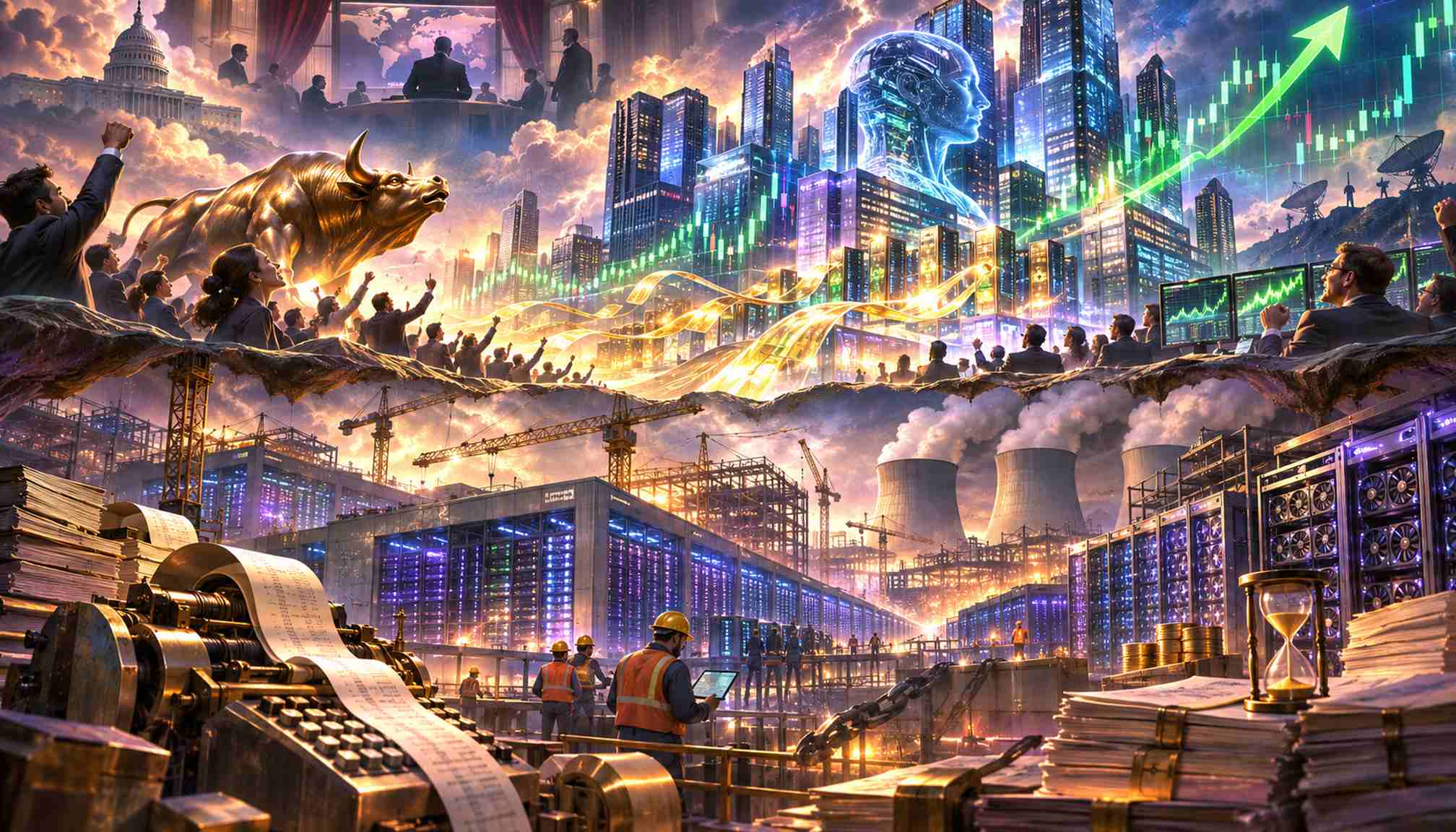

OMG we are not even quite to the Singularity yet and already things are unfolding so fast in the markets as well as the technology space that there’s barely time to keep up with it or write about it within the constraints of trying to maintain a moderately healthy human life...!
Case in point: over the previous weekend I wrote a blog post about what I thought was going on in the AI markets after a pretty brutal few weeks, and was going to do some final editing Monday morning and post it—and then when I woke up Monday and half an hour later looked at the news, I saw that Nvidia’s board had reinstated Jensen Huang as CEO, eleven days after accepting his resignation. Nvidia shares opened more than 30% higher, the Nasdaq and the S&P 500 were each up more than 4% early on, and Nvidia was on track to add more than a trillion dollars of market value in a single day, which would be a first.
So I hastily reframed the post... and then, rereading it a few hours later, found the blow-by-blow already starting to feel like yesterday’s news.
So I’ve rewritten the post once more, this time reframing around what seems to me a more lasting dynamic underneath these specific recent events.
Roughly: it seems to me
- There are two quite different logics by which markets crash and then recover—an older one driven by balance sheets and debt, and a newer one driven by flows, positioning and sentiment
- What the AI markets increasingly show—the November 2026 episode we just saw being a nice example—is both logics running at once, on different layers of the same market.
The way the two logics combine also interacts in interesting ways with two other trends I’ve been harping on: the increasing velocity of the swings back and forth we see as we approach the Singularity, and the increasing entanglement of the AI industry with governments, US and Chinese both.
This builds on two recent posts of mine.
- “Could Big Tech Crash the Economy Even If Their Big Bet on AGI Is Basically Right?”, which was about the longer arc: Big Tech’s capital spending as a race between two clocks, AI revenue growth on one side and the building done in anticipation of it on the other... with the main danger being timing and debt rather than whether the revenue is real (which it clearly is, in some very significant measure). The toy simulation model I described there estimated that an economic depression is unlikely, a full-on crash possible, and moderate disruption arriving in waves as the most likely outcome.
- “Who Brought Down Jensen Huang?”, which is as close to political thriller as this substack usually gets.
The past several weeks read to me like one of the moderate waves I describe in “Could Big Tech Crash…” … arriving more or less on schedule – an equity correction plus a violent unwind of crowded positioning, without (yet) the kind of credit event capable of leading to a truly epic downturn.
What I want to dig into here, though, is not any specific event but rather the shape of such waves, since we’re going to be riding a lot of them on the way from here to Singularity.
The old logic and the new logic
Every real crash and recovery has a mix of ingredients, but I find it’s useful to separate out two pure types.
The old logic is the logic of balance sheets.
In this old logic, a market crash happens because something has gone wrong with the real accounting—too much debt against assets that turn out to be worth less than everyone thought, overbuilt capacity, revenues that arrive later than the loans fall due—and the recovery can’t happen until that accounting has been worked through: debts written down or defaulted on, assets changing hands at fire-sale prices, capital spending cut back, weaker firms absorbed or gone. That takes as long as it takes, which is usually a long time.
The dot-com bust of 2000–2002 (which I remember all too well!) and the 2008–09 financial crisis were old-logic events, and so in a somewhat different way was the rate-driven bear market of 2022, where the slide took the better part of a year because the thing being repriced was the cost of money itself.
The new logic is the logic of flows, positioning and sentiment.
In the new logic, the crash happens mostly because a trade got crowded and leveraged and something shook it. When a leveraged fund’s positions start falling, its risk managers and its lenders force it to sell, whatever its portfolio managers think about the long-term prospects of the companies involved... then that selling pushes prices down further, which forces more selling, and so on until the leverage has been adequately flushed out. The selling is largely mechanical, and the recovery comes as soon as the forced sellers are done and somebody with cash steps in, often helped along by a catalyst—a policy response, a bit of good news, a shiny new product. The timescale is set by positioning and the news cycle rather than by accounting, so it can be weeks or even days.
The new logic has been gaining ground for a while now. T. Rowe Price found that periods of sustained market fear have gotten much shorter, from ten to fourteen months around the dot-com bust and the 2008 crisis to about five in 2011 and 2020, and the three fastest recoveries from a bear-market low to a doubling of the S&P 500 since 1950 have all come since 2008. The tariff shock of April 2025 was an extreme case: the S&P fell more than 10% in six trading sessions and had recouped almost all of it by the end of the month. The reasons are mostly structural: much more trading by passive funds, quant funds and retail investors, same-day options that amplify moves within a single day, and governments and central banks that have gotten quicker to respond to market stress, which has trained investors to buy dips fast.
But the old logic hasn’t gone anywhere. Debt is still debt, depreciation is still depreciation, and a data center financed at 7% still has to earn more than 7%. The interesting question in any given episode isn’t which logic is “right,” but which one dominates, and where.
Both logics at once
One thing I think is distinctive about the AI markets right now—and likely to remain so through future recurrences of this sort of thing—is that both logics run simultaneously, each dominating a different layer of the same market.
The top layer—the stock prices of the big, cash-rich AI leaders, and the broad indices they now dominate—runs mostly on the new logic: crowded positioning, mechanical selling, sentiment, catalysts, fast snapbacks.
The bottom layer—the debt-funded part of the AI buildout, meaning the “neoclouds” that rent out GPU capacity, the data-center developers that borrowed heavily against expected demand, the suppliers that depend on a handful of big customers, and the credit markets that fund them all – runs mostly on the old logic: interest rates, refinancing, utilization, and whether revenue arrives before the loans come due.
The reason for the split is basically the two-clocks structure from my previous post.
- The revenue clock of AI is fast and the excitement around it is faster still, so the equity of the companies that sit closest to AI revenue trades on news, narrative and positioning.
- The buildout clock is slow, and it’s denominated in debt and depreciation schedules—hardware bought today being largely obsolete in about five years, so that being two years early can be very costly.
A market with a fast clock and a slow clock ends up with a fast layer and a slow layer, and each crashes and recovers according to its own logic.
When both run at once you get something that doesn’t look like either textbook pattern: a quick V-shaped rebound in the headline numbers, with a slower, grinding balance-sheet sorting going on underneath, mostly out of sight of anyone who only watches the Nasdaq. The fast layer recovers in days to months; the slow layer takes as long as the accounting takes. And the slow sorting has a pretty predictable direction. This is the process I described last week, where the useful question is less whether AI is a bubble than who can afford to be a little early: firms funding the buildout from cash flow can wait out a glut, while the debt-funded ones may not get the chance.
So—putting these layers and factors together—the most likely outcome of the current market palpitations, as I see it, is not an AI winter or a withdrawal of the economy from aggressive AI-ification, but rather increasing consolidation of the AI industry into an even smaller number of even stronger players. If so this is a consequence of the general (and generally disturbing) phenomenon that in late-stage surveillance capitalism, almost all roads lead to increasing wealth and power concentration... and the two-logics structure is one of the specific mechanisms by which that happens in AI: the fast layer bounces back and the headlines say “phew,” while the slow layer quietly transfers assets from the over-levered to the cash-rich.
The really dangerous case is when the two layers synchronize – when trouble in the slow layer gets big enough to hit the balance sheets of the fast-layer leaders themselves, for instance if stress in AI-infrastructure credit spreads into the hyperscalers’ own bonds. Then the fast layer stops bouncing, because the thing it’s bouncing off of is giving way. That’s the debt channel that drove the worst outcomes in the simulation model I posted last week—but it doesn’t seem to me it’s what we’re seeing right now.
The November 2026 episode as a worked example
I won’t rehash the blow-by-blow of recent market events at too much length… but just to list it out to set context… we have just seen
- a big hedge-fund unwind in October…
- the midterm elections, which markets read as Bad News for AI— though I’m not sure how reasonable the “Democrats as bad for AI” analysis really is... there is for sure an anti-AI strain in the Democratic party (20 years in jail for superintelligence researchers!!) but it’s mainly on the far-left wing of the party which is unlikely to become dominant… and an end to Trump-era policies like high tariffs could potentially boost AI along with many other industries… and centrist Democrats like say Gavin Newsom have in practice rejected attempts at Draconian AI regulation already…
- the Jensen Huang scandal
- Anthropic’s record IPO
- the worst week for US stocks since April 2025
- Jensen’s dramatic return and ensuing Nvidia price upsurge
What’s even more interesting than these soap-operatic twists, though, is how the two logics showed up in it.
The new logic at work
One thing worth reflecting on is how little all this market mayhem had to do with the underlying trajectory of AI technology or the actual AI business. The fundamentals of the AI industry may not yet live up to the Singularitarian prognostications of the more optimistic tech CEO, but they did keep right on getting stronger right through the selloff. Nvidia’s revenue for the quarter that ended in late October was $115.8 billion, more than double the year before, and the stock fell 23% the week it reported. Microsoft’s contracted future commercial revenue stood at $677 billion at the end of September, up 73% year over year, and none of the big cloud companies has cut its spending plans because demand fell off. Anthropic’s IPO was reportedly about seven times oversubscribed in the middle of the worst AI selloff since the boom began. And the models— though certainly not AGI in my book—keep getting better on a timescale of months.
Meanwhile—in the context of these ongoingly strong AI fundamentals—the selling we’ve seen recently has had all the fingerprints of the new logic.
In the late-October phase of the unwind, Goldman’s data showed hedge funds selling existing long positions about three and a half times faster than they were opening new short bets, which smells basically like people cutting risk, as opposed to concluding that AI is a fad.
Retail investors did what retail investors tend to do in a panic: on November 5 they sold more than $330 million of individual stocks, their biggest day of selling since the pandemic crash. They did their best to create a dip for professional investors to then buy into....
And the professional money with cash and patience was fairly open about its intentions: the notes coming out of the big banks mostly said constructive on AI over the medium term, but waiting for less crowded positioning, and Bank of America’s Michael Hartnett pointed out that, historically, the best entry points have typically come after fund managers cut tech all the way to underweight. By mid-November hedge funds had also been piling into short positions (net sellers of US stocks in five of the six weeks through November 12), which is latent buying waiting in the wings, since every short eventually has to be bought back.
And then the catalyst! Nvidia jumped more than 30% on the news of Huang’s return alone, with nothing else about the business having changed over the weekend. You couldn’t ask for a better illustration of a price move driven by sentiment and positioning rather than accounting.
The old logic at work
Underneath, the slow layer was telling a different story, and nothing that happened on Monday changed a single line on any of its balance sheets. Within the AI hardware supply chain the damage was of bear-market scale: as of early November memory-chip stocks were down around 60% from their 2026 highs and AI power stocks around 53%. By mid-October the cost of insuring CoreWeave’s debt had hit distress levels. In Bank of America’s November fund-manager survey, a record share of managers said companies are overinvesting, and 38% named the hyperscalers’ bonds as the likeliest source of a credit event. And the policy backdrop is the opposite of supportive for the slow layer: recent crashes have been short partly because central banks eased into them, whereas this time the Fed is in a hiking cycle (it raised rates in September for the first time in three years), which bears down hardest on exactly the debt-funded part of the buildout.
There are some other boring-ish nuances I probably shouldn’t gloss over. Not everyone who sold on the way down did so judiciously; a lot of the selling was forced, and plenty of supposedly smart money got badly hurt. Insiders at the big AI companies have been heavy net sellers of their own stock for a long time, so there’s no classic signal of executives buying the lows. The professional buyers had less dry powder than you might think, with cash at only 3.6% of portfolios in that same survey. And nobody buys at the exact bottom. None of this changes the overall picture, but it does mean the recovery isn’t guaranteed to be uniform... not even with things zooming up after the happy Nvidia news.
The split outcome
Putting these together, my guess is the split outcome the two-logics picture in its simplest form predicts. The broad market, and the AI companies with strong balance sheets and real cash flows, will likely follow the modern fast recovery, over days (could be starting already), weeks or a few months. The more leveraged corners of the AI industry may go through something closer to what the dot-com infrastructure players went through in 2000–2002, with distressed sales and the stronger players buying up their assets cheaply.
Who comes out of that kind of consolidation well? The hyperscalers with huge operating cash flows, obviously.
Among the AI labs, I suspect Anthropic sees this dynamic pretty clearly: it went ahead with its IPO into the teeth of the selloff and raised more than $80 billion in the offering plus a $26 billion placement—equity rather than debt, just as capital is getting tighter for everyone else, which is to say a slow-layer move made in the middle of a fast-layer panic. Yes their price went down during the days after their IPO, but they know it will go back up, and they walked away with a lot of cash.
SpaceX probably lands on the right side of the split too: it raised $75 billion in its June IPO, has the Starlink business underneath it, owns xAI and has been building out its own compute.
OpenAI is less clear to me. It has enormous reach and closed an $11 billion funding tranche at a $1.25 trillion valuation in the middle of the turmoil, but it has put off its own IPO until next year, and much of the debt financing its buildout sits with partners like Oracle, CoreWeave and SoftBank—exactly the leveraged, slow-layer players most exposed in a credit squeeze.
Faster and faster swings
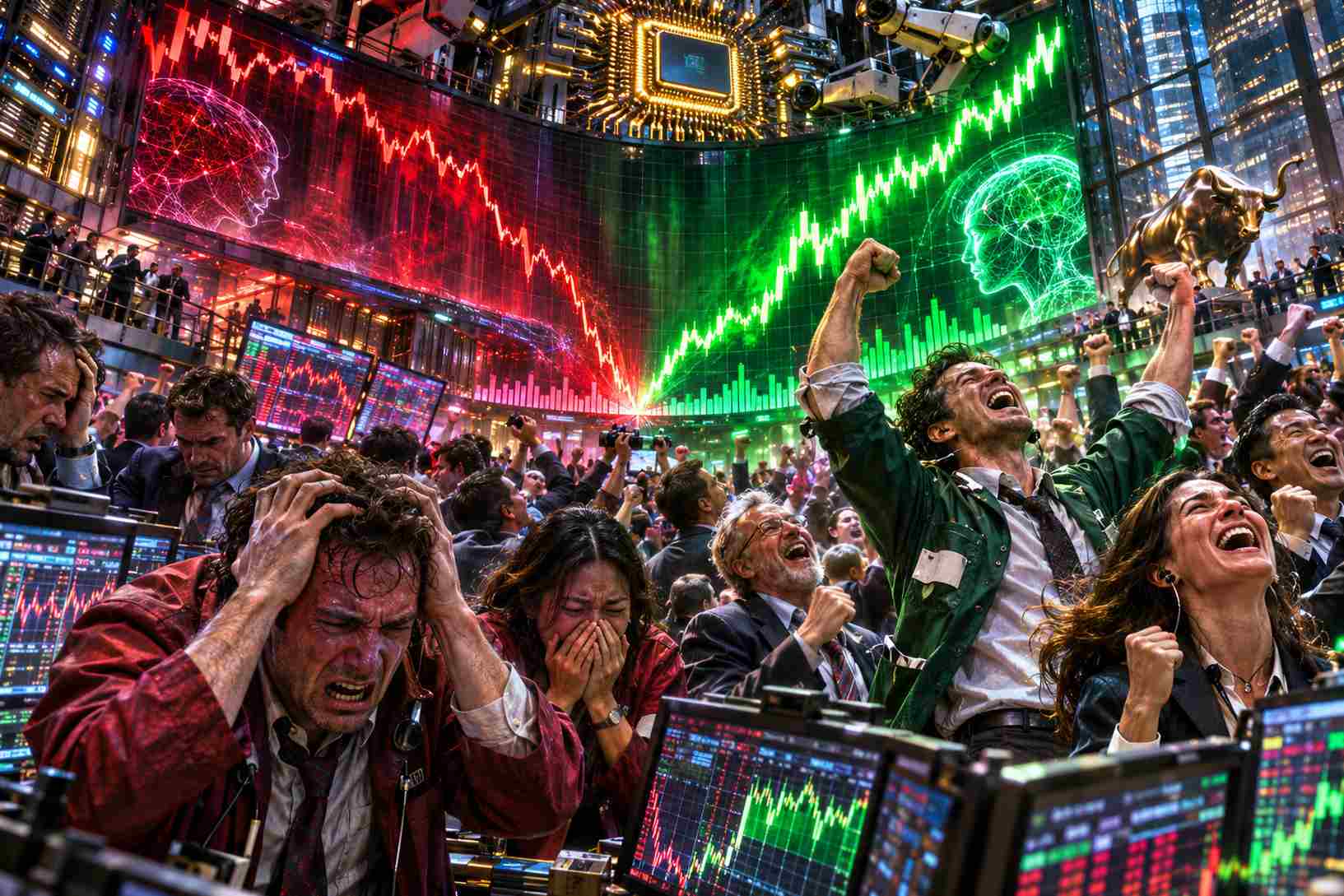
The first of the other two trends I want to tie in here is how fast things now swing. The Singularity is near and market movements are rapidly shifting toward Singularity speed.
In the space of a month Nvidia fell more than 40%, lost its founder and CEO, reported revenue that had more than doubled from a year earlier, kept falling anyway, and then got its CEO back and jumped by roughly a third in a single morning.
I argued last week that the cycle of AI summers and winters has been speeding up; this was a whole cycle in miniature, compressed into a few weeks, and I’d expect this kind of whiplash to get more frequent and more extreme as we get closer to the Singularity.
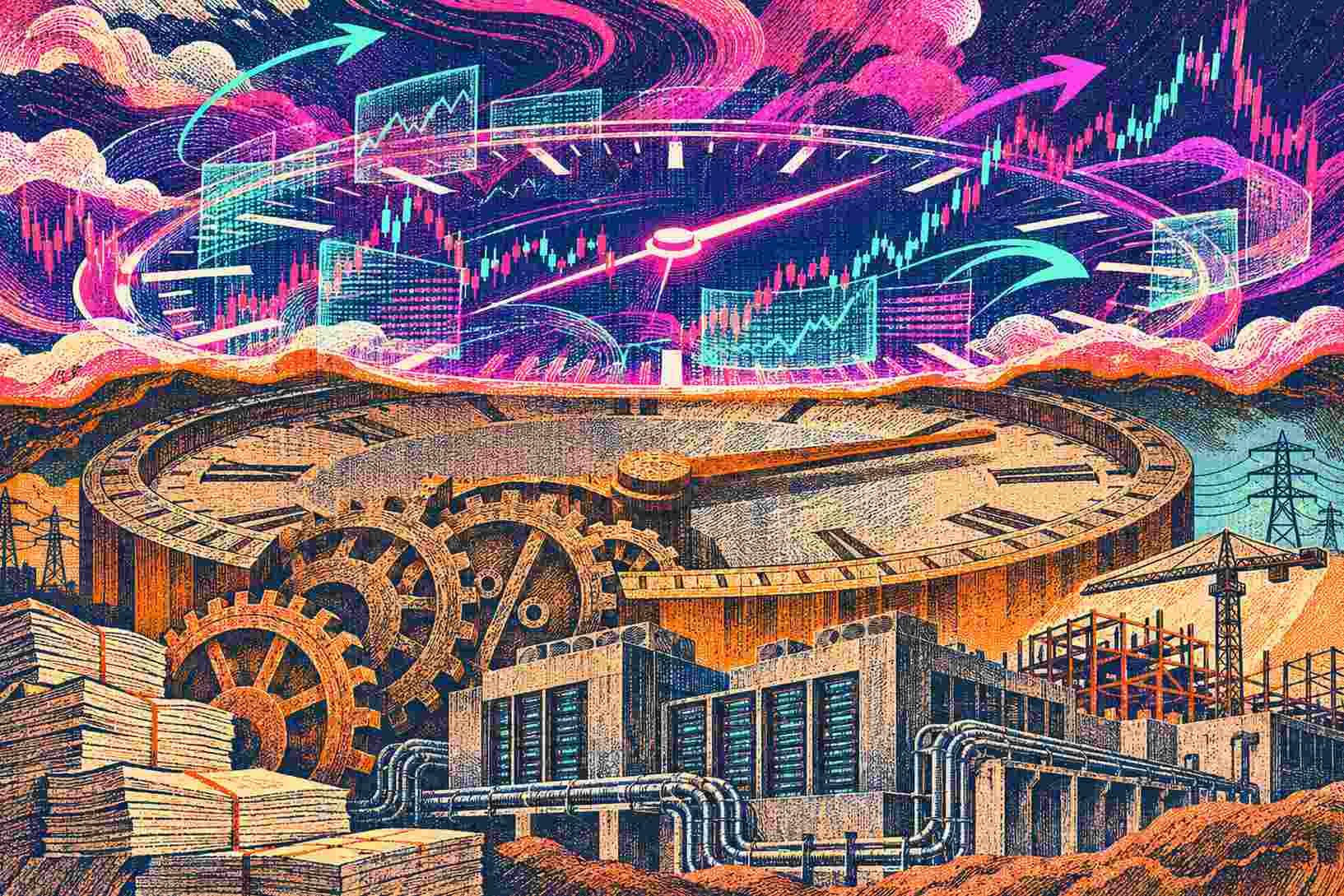
In two-logics terms, what’s speeding up is mostly the fast layer. More passive and algorithmic money, same-day options, a news cycle running at the speed of social media, and AI news that itself keeps arriving faster all mean the flows-and-sentiment layer can now run a whole down-and-up cycle in weeks. The slow layer can’t speed up nearly as much, since its tempo is set by loan maturities, construction timelines and depreciation schedules. So increasingly we get several fast oscillations riding on top of each slow tide.
This has a few consequences. One is that people will keep misreading which layer they’re looking at. A fast crash gets narrated as the AI bubble finally bursting, when the slow layer may be barely moving; a fast rebound gets narrated as “all clear,” when the slow sorting may only just be getting going. Another is that the fast layer’s catalysts are increasingly AI developments themselves. The pattern since ChatGPT has been fairly consistent: every so often the market gets frustrated with AI—over monetization in 2024, over DeepSeek in January 2025, over bubble talk in late 2025—and there’s a short downturn and a stretch of gloomy commentary, and then some new and amazing thing gets launched and people get overexcited about AI all over again.
Interestingly, some new and amazing AI thing arguably did arrive in the middle of the recent episode, and the market mostly shrugged it off in the moment. On November 20, the same day the Nasdaq fell more than 5%, Levent Alpöge, a mathematician at Anthropic, posted a short note saying he believes he has, working with Claude, found a proof of the Riemann hypothesis; a Lean formalization has already passed extensive machine checking, though no human-readable version has been released and nothing will be official for years. If it holds up, it’s about as big a deal as mathematics gets, but it’s such an academic result, so far from any revenue number, that it did little for AI stocks. Fast-layer catalysts have to be legible to traders; a new generation of frontier models, or agents that can reliably do a lot more real work on their own, etc. … and I think there’s a strong chance something like that early next year gives the fast layer its next big upswing.
The third consequence is the one that worries me a little. The more often the fast layer swings, the more chances there are for one of its down-swings to coincide with a stress point in the slow layer—a big refinancing wall, a major customer cutting back—which is exactly the synchronization case where things get properly dangerous. Faster swings don’t make a synchronized crash inevitable, but they do mean more rolls of the cosmic dice.
Governments inside both loops
The second additional trend I want to touch on is the way the AI industry and the US government are now very much two parts of the same system.
Nobody outside a small circle knows the detailed story, but as I argued in my Huang post, factions inside the Trump administration were clearly part of what brought Huang down, since the decisive material came out of classified intelligence assessments. And Trump himself was clearly a big part of what brought him back. As he left for Asia, he said he “would not mind” seeing Huang reinstated, even though his own intelligence agencies had reportedly concluded that Huang had an affair with a suspected Chinese intelligence asset; a week later he was explicitly calling on Nvidia’s board to rehire Huang, and the board’s announcement says it “received input from senior levels of the United States government” before deciding.
In between came the APEC summit in Shenzhen, where Trump said he discussed chips and AI with Xi Jinping but not Huang, adding that some people can’t be replaced and the country has to take care of people like Jensen and Elon. Maybe Huang indeed never came up with Xi; but it’s hard for me to believe the matter wasn’t hanging over that conversation.
One way to read Trump’s intervention is as a “too big to fail” move of a new kind. In 2008 the government saved banks; here the President leaned on a private company’s board to restore a particular person, because a company that is on its own a large slice of the US stock market, and the linchpin of the whole AI buildout, was losing hundreds of billions of dollars of value a week without him.
Here is where the two-logics framing gets interesting in a different way. Government now acts on both layers, and it often pushes them in different directions.
On the fast layer it has become a major source of catalysts: a presidential remark can move a trillion dollars in a morning, and the Huang rescue functioned as a kind of policy put—but a person-specific, company-specific one, aimed at sentiment rather than at any balance sheet.
On the slow layer, meanwhile, government operates by the old logic: the Fed is raising rates, which squeezes the debt-funded buildout, and export rules and import approvals decide whether hundreds of thousands of chips get sold at all—the roughly 600,000 H200 chips already cleared for sale but sitting in Hong Kong because Beijing hasn’t approved their import are a slow-layer fact that no Monday rally changes. So the same state can be propping up the fast layer while tightening the screws on the slow one... which amplifies the split between the two, and with it the consolidation.
Factions on both sides
There’s one more angle on this that I keep chewing on—more than half speculatively, but well, you know what to expect here 8=D... The usual way of telling the US–China AI story is as a contest between two governments. Which it clearly is—however!... one thing the past few weeks show pretty clearly is that each government is itself divided, and in some ways the more interesting contest may be between factions that cut across the two countries.
On the US side the split has been refreshingly public—I suppose because of the Trumpian penchant to let it all hang out... China hawks like Marco Rubio, Jamieson Greer and House China Committee chair John Moolenaar want the most advanced chips kept out of China entirely, while Commerce Secretary Howard Lutnick and Trump’s former AI adviser David Sacks have argued for letting Nvidia sell there, Sacks going so far as to say that the policy of the China hawks is effectively the policy of the CCP, since neither wants American chips in China. Someone on the hawkish side of that divide was very likely part of what brought Huang down; and then Trump, who has said both views are “acceptable,” overruled them and brought Huang back. Yet the hawks didn’t walk away empty-handed: the same week, the White House and Treasury issued new rules requiring US licenses for advanced chips going to Singapore, Malaysia, Thailand, Indonesia and Brazil, and US permission before any data center using Nvidia chips rents computing power to Chinese customers. My 20 year old neo-Marxist self would have called this a textbook instance of dialectical materialism ;=)
Beijing looks similarly divided, though its divisions are harder to see from outside. Chinese tech firms have been desperate for Nvidia hardware; they reportedly ordered around 2 million H200s for 2026, far more than Nvidia had in stock. But the government has prioritized self-reliance and its domestic champions, Huawei above all, and has held back large-scale imports, so that roughly 600,000 H200s now sit in Hong Kong awaiting approval. It has floated quotas tying Nvidia purchases to purchases of domestic chips, approved batches at convenient moments, and let small quantities trickle in through intermediaries – less a settled policy than a government keeping all its options open, using Nvidia as a stopgap while Huawei catches up without quite wanting to commit to either dependence or a clean break.
Put the two sides together and a pattern suggests itself. The growth-maximizing, trade-friendly factions in both capitals—the ones who want AI to spread and scale as fast as possible and are happy to do business across the Pacific to make that happen—seem to be winning the big decisions... I mean—Huang is back, Nvidia’s China business is alive if constrained, and the summit in Shenzhen produced talk of chips and AI rather than a rupture. The more nationalist factions on both sides aren’t being squashed. They keep winning partial victories at the edges, a new licensing rule here, an import hold there, but they look to be operating in a subordinate role, shaping the terms of the flow rather than stopping it.
And notice how neatly this maps onto the two logics. The growth factions mostly operate on the fast layer—rescues, reassurances, summit headlines, the stuff that moves sentiment in a morning. The nationalist factions, along with the central bank in its own very different way, mostly operate on the slow layer—licenses, import approvals, interest rates, the stuff that determines over months which balance sheets hold up. Which is, again, a recipe for fast rebounds at the top and slow sorting underneath. If this reading is right, the forces pushing toward maximal global AI growth are very strong, and governments are increasingly instruments of that push as much as brakes on it—though I am really not totally sure on this part. The new rules are real, Beijing hasn’t released the Hong Kong stockpile, and both Lutnick and Huang are due to testify before the Senate on December 3, so the balance could look quite different in a couple of weeks. And then quite different again a couple weeks after that!
The disturbing dynamics all this will make clearer
If things go roughly the way I’ve described, the AI industry that comes out of each of these waves of market mayhem will be a bit more centralized than the one that went in. Fewer companies will own the frontier models, the data centers and the chips, and the ones that remain will be bigger, richer and more entrenched. Some of them are controlled in very concentrated ways; SpaceX’s dual-class share structure, for instance, keeps Elon Musk firmly in control of a company that now owns one of the main frontier labs. And when regulation arrives in a highly consolidated industry, it tends to entrench the incumbents, who can afford the compliance costs and the lobbyists, rather than restrain them.
This is not especially what I would like to see happen, but I’m just following the socioeconomic dynamics where they seem to go. An optimistic take on this outcome would be: It will make the case for more efficient and more hardware-flexible AI, and for decentralized AI infrastructure, a lot clearer and even stronger than it is today.
The first part of that is the case for AI that gets more intelligence out of less compute and is more flexible about the hardware it runs on. In two-logics terms, this is AI whose progress depends less on the slow, debt-bound layer. Much of what the market is nervous about is the financing of the dominant approach, scaling up very large neural networks on huge clusters of tightly interconnected GPUs, and with the Fed hiking and lenders getting cautious, “just make it bigger” becomes a much more expensive strategy. Neural-symbolic AI is one family of alternatives: it combines neural networks, which are good at recognizing patterns in messy data, with explicit symbolic knowledge and reasoning methods such as probabilistic logic, which can reuse what has already been learned and generalize from far fewer examples. Our OpenCog Hyperon framework works this way, with neural models plugged into a shared knowledge store and a probabilistic logic engine, so the system doesn’t have to relearn everything inside the weights of one enormous model. Predictive coding is another: a brain-inspired way of training networks in which each layer learns from its own local prediction errors, rather than from an error signal passed backward through the entire network in one big coordinated step, as in standard backpropagation. Local learning makes these networks more amenable to continual learning and to running on less tightly coupled, more heterogeneous hardware.
That flexibility ties into decentralized infrastructure. Every time the slow layer sorts itself out, there will be a fair amount of stranded compute floating around, available cheaply to whoever has a good use for it. Decentralized networks like the ones SingularityNET and the ASI Alliance have been building, including the ASI:Chain infrastructure we’re building to host AI agents across heterogeneous hardware, are designed to pull together exactly that kind of scattered capacity. In last week’s model, decentralized networks taking a large share of AI revenue was bad news for the debt-laden incumbents but tended to lower the wider economic risk, partly because the networks can put stranded hardware back to work. After all, while ALMOST all roads lead to increasing wealth and power concentration... there are some that do not, such as scenarios where the breakout to full-on human-level AGI happens with non-hyperscaler-bound AI architectures running on decentralized networks like, oh say, ASI:chain...
The second part is the urgency of decentralization itself. I’ve been arguing for a long time that it’s dangerous for the most powerful AI systems in the world to be owned and controlled by a handful of large companies and the governments they’re entangled with. During a boom in which money seems to flow to everyone, that can sound abstract. The Huang episode makes it concrete: when the leadership of a single chip company becomes a matter for the President, the intelligence agencies, half a dozen congressional committees and, at least in the background, a summit with Xi Jinping, the entanglement of AI companies and governments is no longer a figure of speech. The more concentrated the industry gets, the more of AI’s future gets decided in exactly that kind of room, and the time to build the alternatives is before the post-crash structure of the industry hardens.
Where this leaves us
To boil down and reiterate my key point here: crash recoveries come in two logics, an old balance-sheet logic and a new flows-and-sentiment logic, and AI markets now run both at once—fast rebounds in the prices of the cash-rich leaders riding on slow balance-sheet sorting in the debt-funded buildout underneath. The fast layer keeps swinging faster as we approach the Singularity, and governments are now inside both loops, often propping up the one while squeezing the other. The net effect, in this episode and I suspect in a lot of future ones, is quick recoveries in the headline numbers and steady consolidation underneath, with the synchronization of the two layers as the thing that could turn a wave into a real crash.
As for the current episode, with Monday’s rally in mind and without any overweening confidence about the next week or few, my take is that the recent selloff is a dip—one of the moderate waves of disruption I highlighted last week—rather than the opening of the crash scenario. The headline recovery could take days, weeks or conceivably even a few months (hah! I doubt it…), but I’d be very surprised if it took longer. The main way I could be wrong is exactly the synchronization case: stress in AI-infrastructure credit spreading into the hyperscalers’ own bonds, especially with the Fed hiking into it.
Whatever the next week brings, I’d expect more swings like this one, and crazier and faster ones, with Washington, and Beijing too, increasingly inside the loop. And one way or another, the AI industry that comes out the other side of the current phase is likely to be more concentrated—which is exactly why we will need efficient, hardware-flexible, decentralized AI even more desperately than we do today.