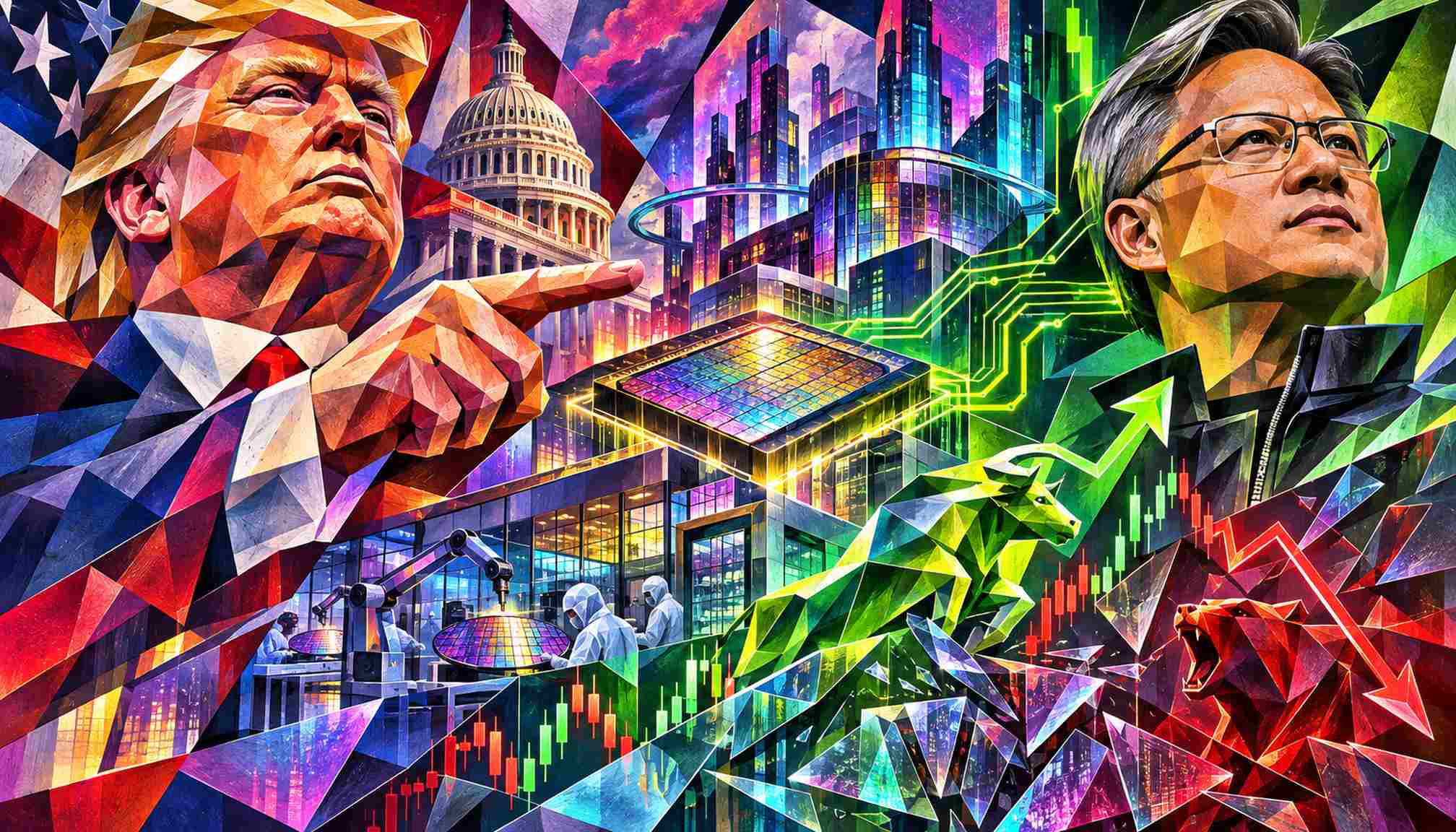

Eleven days! That is how long the world's most valuable semiconductor company had to endure the absence of its founder before Jensen Huang was reinstated as NVIDIA's CEO, president and board member on November 23. His return followed an extraordinary intervention by Donald Trump, whose administration provided national security assurances to NVIDIA's board. The board, which had previously ruled out his return, unanimously welcomed him back. Wall Street celebrated, NVIDIA recovered nearly a trillion dollars in market value in a single trading session, and humanity could apparently resume its journey towards the Singularity.
In my earlier article, NVIDIA Without Jensen Huang: The $1.8 Trillion Warning About Corporate Cults and the AI Bubble, I expressed my concern about a fundamental weakness of contemporary capitalism: our increasingly irrational dependence on corporate personalities, the financial mythology we construct around them, and the speculative machinery that turns their personal fortunes and misfortunes into economic events of global significance. Little did I know that the American presidency would provide me with another illustration of my argument within eleven days!
Note to the bored reader: Yes, this same episode’s plot has played out before in the Silicon Valley reality show. My focus will not be on the childish plot, and I will try to shift your perspective to the disturbingly ignored reality of corporate accountability as a major economic risk. On the silly plot… We all remember Sam Altman, whose dismissal in November 2023 lasted a mere four days before OpenAI announced his return? Apparently, the only human beings we cannot afford to replace in the age of AI are the very ones promising to replace the rest of us!
Has Jensen Been Cleared, or Has He Simply Been Reinstated?
For those who have not been following this rather expensive soap opera, Huang publicly acknowledged his marital infidelity on November 8. Among the reported relationships was one with Alice Huang, an executive formerly associated with Megaspeed International, who was alleged to have connections to Chinese intelligence. There were also reports of intimate relationships with at least two NVIDIA employees. Huang has admitted infidelity but has not publicly confirmed each of these alleged relationships.
Now, I have no ambition to investigate Jensen's marital affairs (I have explicitly stated this in my previous article as well). There are enough publications dedicated to the recreational activities of wealthy people. However, when those activities raise questions about corporate governance, conflicts of interest and the potential exposure of strategically important technologies, I agree then that they cease to be exclusively personal matters.
On November 25, Reuters reported that the US Department of Justice had not conducted a formal investigation specifically targeting Jensen Huang before his reinstatement. Attorney General Todd Blanche's assessment was based on information gathered during ongoing investigations into two NVIDIA customers, Super Micro Computer and Megaspeed. Investigators had reportedly found no evidence that Jensen knowingly transferred sensitive technology to China or acted as a Chinese agent.
Meanwhile, the Singaporean Ministry of Home Affairs confirmed that Alice Huang had received a stern warning and had been barred from returning to Singapore after knowingly providing inaccurate information about her involvement in Megaspeed. However, Singapore explicitly stated that its investigation did not concern espionage, and Reuters has been unable to independently verify her alleged connections to Chinese intelligence.
The American investigation into Megaspeed remains active, as does NVIDIA's internal investigation into the possibility that Jensen was targeted by foreign intelligence.
Hence, Jensen's reinstatement is neither evidence of his guilt nor the conclusion of every investigation concerning the scandal. I sincerely hope he is innocent of any national security wrongdoing. Nevertheless, I am considerably more interested in understanding why his return became a matter of such urgency for the American government.
Is the American Government Afraid of an AI Bubble?
During his November 23 interview with CNBC, Trump was asked whether the preceding week's stock market sell-off influenced his decision to intervene.
“Probably so,” he responded, before explaining that his greater concern was NVIDIA's long-term technological importance to America.
When subsequently asked whether he was worried about an AI bubble, Trump responded that he was not concerned now, explaining that one of America's great technological stars was back in the game.
Emm... did the bubble cease to exist because Jensen got his job back? What an extraordinary discovery in macroeconomics! Perhaps economists should abandon their complicated studies of asset valuations, debt, productivity, capital expenditure and monetary policy and start paying closer attention to the employment contracts of our technological celebrities!
To be fair to Trump, his argument was also geopolitical. He considers Huang's technological expertise a strategic American advantage and expressed concern about the possibility of losing that advantage to China. Such concerns are understandable in the context of the current geopolitical competition over AI. However, the whole argument is Trump-ish which assuming Huang will get hired by the Chinese which is 1) a weak assumption, and 2) a shocking assumption which assumes China will not discover what NVIDA has unless it steals it.
Regardless of China, the financial implications cannot simply be dismissed. Axios reported that people familiar with the discussions described arguments made to Trump that Huang was effectively too important to the American economy to lose.
And there is an important distinction here. Whether NVIDIA is strategically indispensable to America and whether Jensen Huang is indispensable to NVIDIA are two entirely different propositions. Yet the financial markets, and apparently some of Washington's decision-makers, seem increasingly inclined to treat them as one.
What happened to America's faith in the free market? Instead of trusting the market to assess NVIDIA on the merits of its technology, productivity and profitability, Washington seems to be betting on investors' continued willingness to buy into the mythology of the irreplaceable corporate messiah. What a peculiar form of capitalism! And here comes my big MAYBE: perhaps Washington knows, or at least seriously fears, that we are sitting on an AI bubble, and keeping it inflated has become such an economic and political priority that even the White House feels compelled to interfere in the internal affairs of a private corporation. If so, are we protecting the American economy or merely postponing its appointment with reality?

The Economic Nightmare Behind the Political Intervention
On November 13, just one day after Jensen's departure was announced, the Federal Reserve published its Financial Stability Report. Artificial intelligence emerged as the most frequently cited risk among the 23 financial-market contacts surveyed for the report. Their concerns included excessive valuations, uncertain returns on AI investments, debt-financed infrastructure expansion and circular financing arrangements.
The Federal Reserve itself also warned that disappointing returns on business investment could weaken economic growth, depress asset prices and tighten credit conditions. The International Monetary Fund's October 2026 Global Financial Stability Report had raised similar concerns about the concentration of financial exposure to AI and the possibility that leverage could amplify a market correction.
Why should Washington care? Because the AI economy is no longer confined to a handful of experts in Silicon Valley developing sophisticated algorithms. Its fortunes are increasingly connected to surveillance and military, retirement portfolios, banks, energy companies, construction businesses, semiconductor manufacturers, medical industry, government revenue and the investment plans of some of the largest corporations in history.
NVIDIA occupies a particularly interesting position within this economic arrangement. It sells the hardware upon which much of the AI industry depends while simultaneously investing in companies that purchase its hardware. These companies, in turn, raise money based partly on expectations about the capabilities and commercial applications of the intelligence they intend to develop using NVIDIA's products.
I am not suggesting that every such financial arrangement is fraudulent or economically unjustifiable. But I am questioning the wisdom of constructing an entire industrial ecosystem in which the financial health of so many participants depends on a relatively narrow set of assumptions about the future.
What happens when those assumptions are wrong? And, as Ben Goertzel has examined in his article Could Big Tech Crash the Economy Even If Their Big Bet on AGI Is Basically Right?, what happens even when those assumptions are right, but the anticipated revenues arrive considerably later than the bills?
Unfortunately, creditors have the rather unpleasant habit of operating on a different timeline from AGI researchers. You cannot indefinitely postpone the repayment of a loan by announcing that the Singularity is getting closer!
Did NVIDIA Really Become Less Productive Over the Weekend?
Let us examine the numbers, because this is where the absurdity becomes particularly interesting.
On November 17, under the interim leadership of Colette Kress, NVIDIA announced quarterly revenues of $115.8 billion, representing a 103% increase over the corresponding quarter of the previous year. Its data centre business alone generated $107.6 billion, while net income reached $65.3 billion.
Naturally, these results reflect a quarter completed before Jensen's departure. These numbers shows the company is doing well. My point is that NVIDIA remained an extraordinarily productive and profitable enterprise. Then the moment, the CEO is fired, its shares continued falling.
By Friday, November 20, NVIDIA's share price had reached $125.53. When Jensen returned on Monday, the shares closed at $165.05, an increase of approximately 31.5%. Nearly $950 billion in market value had been restored.
So here you see two extreme opposites mirroring one another.
What exactly happened to NVIDIA's productive capacity between Thursday November 12 morning and Monday November 16 evening? Did its engineers lost their semiconductor architecture? Did the company's factories somehow become less productive? Did it lost another trillion dollars' worth of machinery while the rest of us where worrying our weekend?
What exactly happened to NVIDIA's productive capacity between Friday November 20 evening and Monday November 23 morning? Did its engineers discover a revolutionary semiconductor architecture? Did the company's factories somehow become more productive? Did it acquire another trillion dollars' worth of machinery while the rest of us were enjoying our weekend?
No such corresponding transformation in its a) lessen productive capacity in case of scenario one, and b) increased productive capacity in case of scenario number two was announced. Investors had simply revised their expectations about NVIDIA's future based on pure speculation! This is what our capitalism boasts, oh what a healthy global economy!
So let me go on with the more good news, let me spread the gospels of our healthy capitalism. By Friday, November 27, NVIDIA's shares had retreated to $150.49, surrendering roughly $350 billion of the market value recovered during Jensen's triumphant return.
These are changes in market valuation, not equivalent amounts of cash appearing and disappearing from NVIDIA's bank accounts. Nevertheless, their consequences for investors, borrowers and the wider economy can be very real.
Ben's more recent article, Two Logics of Crash and Recovery, makes an important distinction between rapid market movements driven by sentiment and the considerably slower economic adjustments imposed by debt, profitability and actual financial obligations.
Jensen's return may have addressed the former. I fail to see how it has resolved the latter.
Too Big to Fail, Too Big to Fire?
On November 25, US Senator Cory Booker demanded answers from NVIDIA's board concerning Trump's involvement in Jensen's reinstatement. Among his concerns was that the economic dominance of a company could give it extraordinary leverage over the government officials responsible for holding it accountable.
Booker requested records of communications between NVIDIA and the administration, including discussions about export controls, antitrust enforcement, national security assurances and the potential financial consequences of Jensen's departure and return.
This is where the problem of corporate cults, which I raised in my earlier article, acquires an entirely new dimension.
Suppose a corporate board believes that its CEO has violated the company's code of conduct. The board is entitled, and in certain circumstances obliged, to act. But suppose the financial consequences of such an action threaten the stability of a significant portion of the economy because our super health capitalism is nothing but pure speculation today. The government may then acquire an economic incentive to persuade the board to reverse its decision.
What happens to corporate accountability under such circumstances? Should a CEO's personal conduct be judged differently depending on how many pension funds hold shares in his company? Does one's eligibility for forgiveness increase in proportion to one's company's market capitalization?
My concern is not that Trump necessarily intervened to conceal wrongdoing. There is no established evidence for such a conclusion. My concern is that we may have constructed an economic system in which the enforcement of corporate accountability itself becomes a perceived threat to economic stability.
The American government has spent years trying to prevent its geopolitical competitors from acquiring a decisive advantage in artificial intelligence. But perhaps it should devote an equal amount of attention to preventing its own economy from becoming dangerously dependent on the fortunes of a handful of individuals and corporations.
I wish Jensen Huang well, and I admire what he and the thousands of engineers at NVIDIA have accomplished. But I would be considerably more optimistic about NVIDIA, the AI revolution and capitalism itself if the absence of one man for eleven days did not require the economic intervention of the most powerful political office on the planet.
For God's sake, we are attempting to build an intelligence that might eventually surpass the collective intelligence of humanity, and yet we have apparently failed to build a semiconductor company whose investors can tolerate the temporary absence of one human being!